Tuesday, Oct 30 2012
Has the mystery of the Moon's dark side
been solved? Scientists say differences in
lunar areas could be due to a giant cosmic impact
- Japanese
team say the giant cosmic impact created a magma
sea more than a thousand miles wide and several
hundred miles deep
- Theory
explains why moon's near and far sides are so
different
By Mark Prigg
The largest lunar dark spot, a
massive 1,800 mile wide (3,000 kilometers) crater
known as the 'Ocean of Storms', may be a scar from a
giant cosmic impact, researchers believe.
A Japanese team say the giant
cosmic impact created a magma sea more than a thousand
miles wide and several hundred miles deep.
These findings could help
explain why the moon's near and far sides are so very
different from one another, the team say.
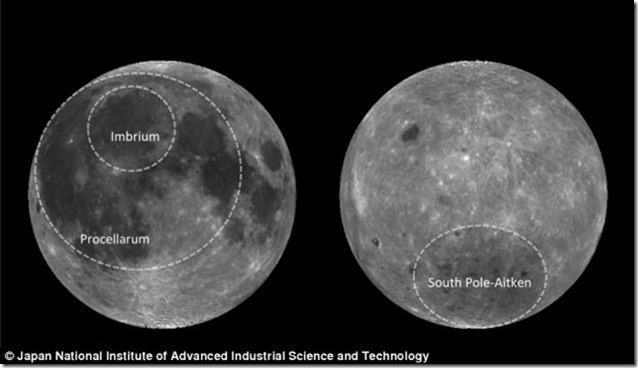
The two sides of the moon: Researchers now
believe Procellarum, the largest of the three
massive impact basins shown here, was formed by a
massive cosmic collision
'Our discovery provides the
first compositional evidence of this idea, which could
be confirmed by future lunar sample return missions,
such as Moonrise, a proposed NASA mission that would
send an unmanned probe to collect lunar dirt and
return it to Earth,' lead study author Ryosuke
Nakamura, a planetary scientist at the National
Institute of Advanced Industrial Science and
Technology in Tsukuba, Japan, told SPACE.com.
'The neighboring Earth likely
experienced similar-sized impacts around the same
period,' Nakamura added.
'It would have had a great
effect on the onset of Earth's continental crust
formation and the beginning of life.'
Scientists analyzed Oceanus
Procellarum, or the Ocean of Storms, a dark spot on
the near side of the moon more than 1,800 miles (3,000
kilometers) wide.
Researcher already know the
near side of the moon, the side that always faces
Earth, is quite different from the far side (which is
often called the dark side, even though it does get
sunlight).
Previous studies have found
widespread plains of volcanic rock called 'maria'
cover nearly a third of the near side, but only a few
maria are seen on the far one.
Now scientists in Japan say
that a giant collision may also explain the moon's
two-faced nature, one that gave rise to the Ocean of
Storms.
More...
Researchers analyzed the
composition of the moon's surface using data from the
Japanese lunar orbiter Kaguya/Selene.
These data revealed that a
low-calcium variety of the mineral pyroxene is
concentrated around Oceanus Procellarum, the Ocean of
Storms, and large impact craters such as the South
Pole-Aitkenand Imbriumbasins.
This type of pyroxene is
linked with the melting and excavation of material
from the lunar mantle, and suggests the Ocean of
Storms is a leftover from a cataclysmic impact.
This collision would have
generated 'a 3,000-kilometer (1,800-mile) wide magma
sea several hundred kilometers in depth,'
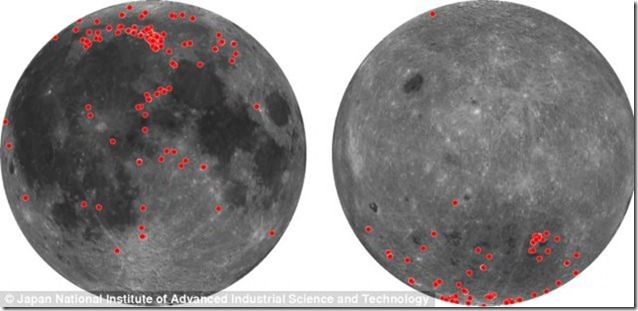
The red points show high
low-calcium pyroxene concentrations, discovered
through data mining of Kaguya's spectral data
archive, and are signs of a cosmic impact.
The researchers believe
collisions large enough to create Oceanus Procellarum
and the moon's other giant impact basins would have
completely stripped the original crust on the near
side of the moon.
The crust that later formed
there from the molten rock left after these impacts
would differ dramatically from that on the far side,
explaining why these halves are so distinct.
The scientists detailed their findings online Oct. 28
in the journal Nature Geoscience.