SONG OF SOLOMON
RAPTURE
MATURING OF THE
SUMMER FRUIT
The Redemption of the Shulamite Shepherdess
by Luis B. Vega
vegapost@hotmail.com
www.PostScripts.org
The purpose of this study is to make the correlation and argue
that there are Rapture timing clues in the Song of Solomon,
but in the Summer and tied to wine. Every year, as the Spring
Season approaches, it has been natural to consider the
Rapture’s timing to correspond to the Spring Feasts of
Jehovah. It is how the Song of Solomon is introduced in terms
of the Season. However, the entire story’s arc is not
considered. In doing so, it shows that the Rapture’s timing
corresponds to a maturing of the Summer Fruit, in one’s
estimation. It is about the Shulamite, which, like a fruit, is
maturing.
So, it is how the Summer Harvest is more pertinent to the
Rapture’s timing in the Song of Solomon than the Springtime is.
It is about a love song between Jesus, the Greater Solomon and
the Bride of Christ, the Greater Shulamite. It is about ‘Love
rising’ and how it is like a Seal in one’s arm. It is about a
deep and inner call to spiritual maturity that is required to be
worthy of the King of Peace, i.e., Solomon. It is to have Jesus
in one’s heart, mind, soul and body, ultimately, just what is
expected in a marriage
It is about the King’s calling to forfeit all of one’s
earthly aspirations that hinder responding to the call of the
King in one’s life. It is about a real relationship with the
Creator, with Jesus. It is about knowing and realizing that
ultimately, at the end of one’s life, that is what will only be
taken into Eternity. The call is like a marriage in how Jesus
has been asking individuals throughout this Church Age to
‘marry’ Him. He is looking for an ‘I Do’. It is a vow to serve
and obey, which in modern times is no longer accepted.
In reading the Song of Solomon, one realized that such a
relationship is complicated and convoluted at times. How so? The
Shulamite, in response to the call of the King experienced loss,
misunderstanding, and mistreatment. And that is exactly what one
will experience in responding to Jesus in this world. But it is
because of the type of love for the King and an expectation that
the world does not care for, is interested or facilitates. What
about the call of Jesus in one’s life? It is about Him wanting
everything that is you. And conversely, it is an expectation of
only seeking and wanting the King, Jesus.
And it will be at the Rapture that this ultimate
rendezvous and union will be actualized. Thus, it is critical to
have what is needed to mature as the Shulamite did to be found
worthy of that call at the end of the Summer Fruit Season. Only
through such maturing will one eventually find oneself at that
level of readiness. It is to be with the King. That is how the
Song of Solomon ends. It is to be with the King in His presence,
holy as He is Holy. This does not mean sinless perfection, but a
sanctification process done through the Holy Spirit. What does
that look like in this maturing or Journey of Faith with Jesus?
The Cost of Serving
It is about that if one says, they have a relationship with
Jesus, or is ‘Saved’, then the highest form of demonstrating
that love in the commitment is to serve and obey the King.
Sadly, this comprehension has been rejected in modern society,
deliberately, but more tragically within the Professing Church.
In the West, a marriage vow is only pledged so long as it is
convenient, assuming all things being equal and normal aside
from abuse, etc. But it has been the Enemy of Jesus and His
people that have wreaked havoc on Marriage to destroy what
according to Jesus it had been designed for.
Marriage in the West is now a mockery. By destroying
Marriage, it has destroyed what it means to be a Father, a
Mother, a Son and a Daughter. Just by one saying this is now
considered Hate Speech in the West. But one’s point is that the
Rapture’s timing is or could be tied to a Summer timeframe. And
if one interjects one’s call and commitment to that of the
Shulamite, one will see that one’s Journey of Faith is like
fruit also. It is like the fruit that needs to be ripened in
order to then be harvested in the Summer.
Thus, could this be the timing when the Greater Solomon
will come calling to sweep-up his Shulamite and bring her into
his Father’s house? So, to that end and given this framework,
one will now attempt to show how the story arc insinuates a
Summer conclusion. It is despite the Spring timing of the
Rapture typology being surmised. One is arguing that it is just
the prelude to the Summer timing of when the harvest occurs of
all those types of fruits noted in the story. This study will
also show that in fact, nearly every chapter, of which there are
8 of them, have a wine or New Wine theme to them.
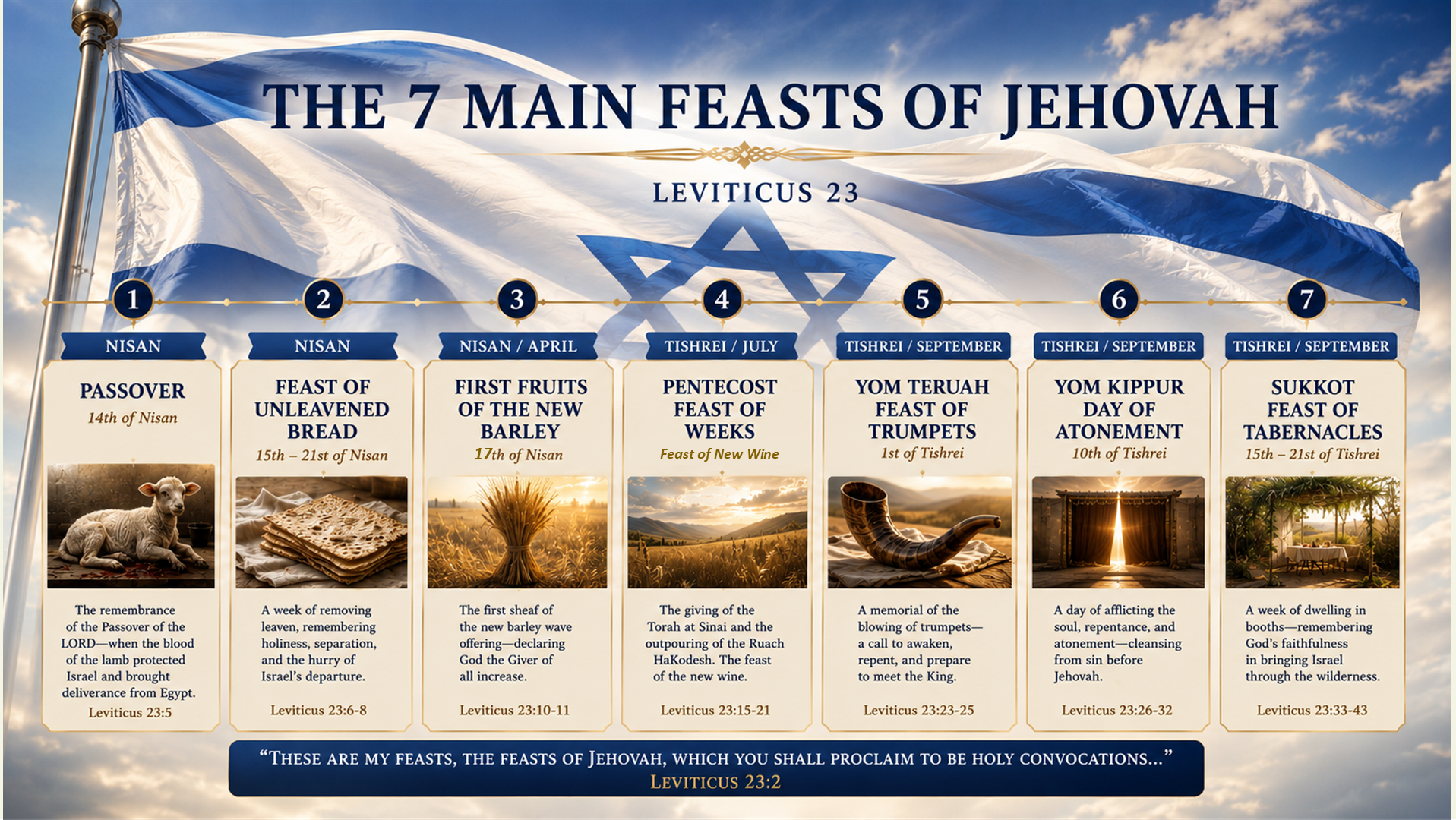
This is how the study will tie the wine to one’s July 23
(723) end of the Summer Wheat Harvest Rapture timing theory. It
is because one has argued that this 2nd Pentecost First Fruits
corresponded to the Acts 2 Pentecost timing. And that
corresponded to the First Fruits of the New Wine, in one’s
interpretation. And that, in turn, is what could be connected to
the Rapture’s timing. That is one’s working theory until further
notice.
So, the following will be one’s commentary and to show the wine
or New Wine inferences and possible Summer timing of the
Rapture, rather than a Spring one. As to the name, ‘Shulamite?’
It is the feminine version of Solomon. Essentially, she is ‘Mrs.
Peace’, as that is what Solomon means, ‘Peace’. Ultimately, it
is in reference to Jesus, the Prince of Peace. Here are the
highlights referencing wine in most of the 8 chapters.
CHAPTER 1
Notice that the Song of Solomon is true Hebraic poetry. It
starts with the Bride describing how Solomon’s love is more
‘delightful than wine’. Right from the beginning, the theme of
the wine is what sets the tone until the very end.
Perhaps one is reading the Rapture and the New Wine
connection too much into the Song, but here are the
presumptions. Notice the inference to being ‘taken away’ and
brought to the Chamber, the Wedding Chamber. See Isaiah 26:20
and the Astronomy of Psalm 19:5. It is about the Sun chasing
after, as in a race or course, i.e., the Ecliptic.
1:2 Let
him kiss me with the Kisses of his Mouth! For your Love is
more delightful than Wine.
1:4 Take
me away with you—let us hurry! May the King bring me to his
Chambers.
Then consider how the Bride references, yet again the
correlation of the Vineyards of En-gedi. En-gedi is a Hebrew
term that means ‘Spring of the Kid’ or ‘Fountain of the Goat’.
En-gedi is known for its lush vegetation and freshwater springs,
making it a notable oasis in the arid region. It is also
significant in Biblical history, as it is associated with
stories involving King David, who sought refuge there from King
Saul.
1:14 My
Beloved is to me a Cluster of Henna blossoms in the Vineyards
of En-gedi.
CHAPTER 2
In this Chapter, the Bride describes herself as the Rose of
Sharon. One has done a word study of how in the Hebrew, this
phrase can be interpreted phonetically as ‘Rashon of Ahron’. It
means ‘I AM the Last and the First’.
2:1 I
am a Rose of Sharon, a Lily of the Valley.
It is a complement to who and what Jesus is, the Great I
AM. And then notice again now in verse 4, there is that
reference to the wine.
2:4 He
has brought me to the House of Wine, and his Banner over me is
Love.
Now, this next section of the Song of Solomon is the most
popular one. It is what is usually used to surmise that if one
applies the timing of the Rapture as a prophetic typology is to
occur in the Spring. However, one’s argument is that it is where
the ‘story’ of the fruit maturing begins. It is what leads to
the actual rendezvous with the King during the Summer Harvest at
the end. It is because the Spring season is when all the fruit
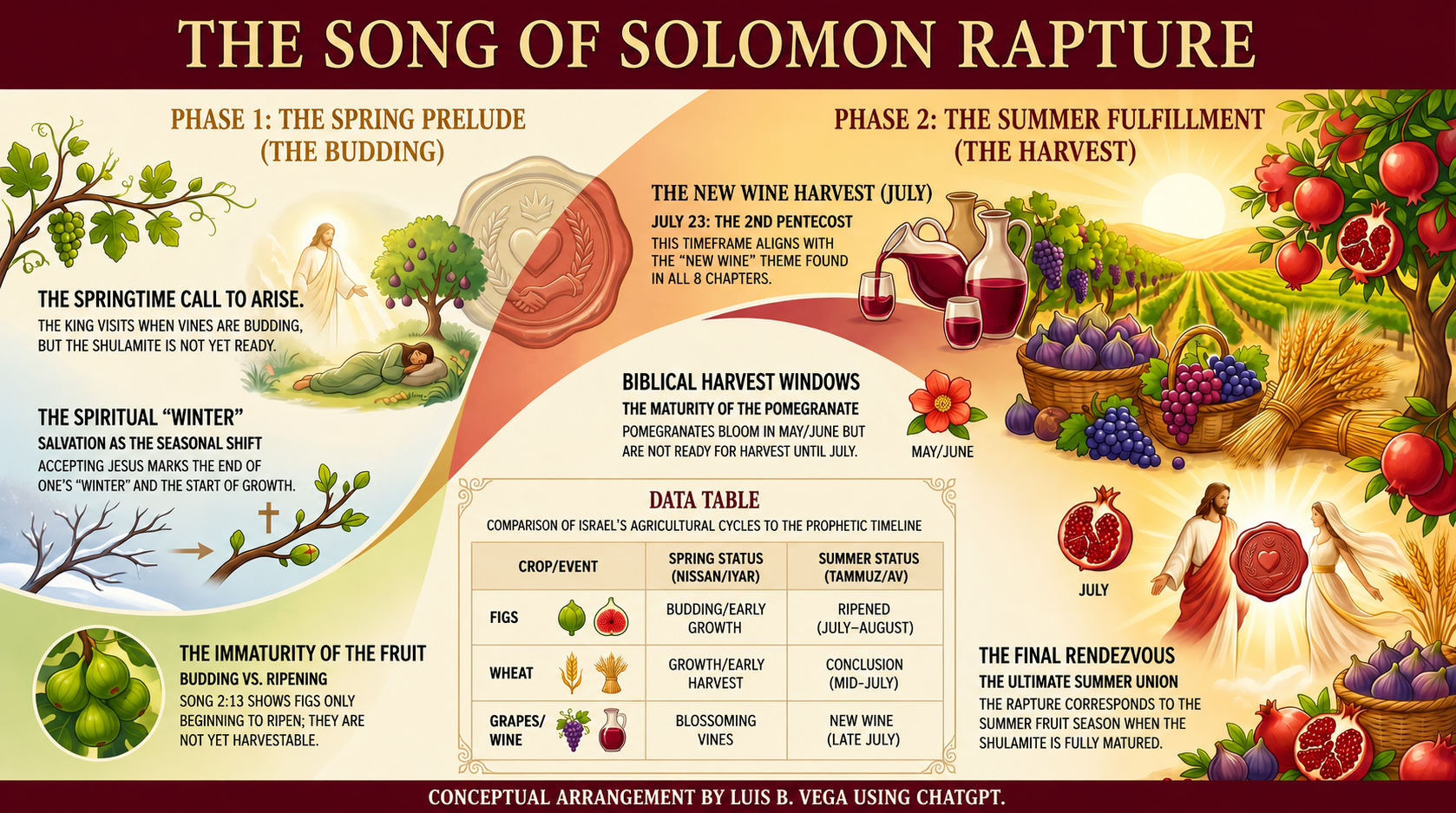
types mentioned in the storyline are only budding. But realize
that this Spring initial scene is where Solomon only comes to
visit the Shulamite.
2:13 The
fig tree ripens its figs; the blossoming vines spread their
fragrance. Arise, come away, my Darling; come away with me, my
Beautiful One.
It is as if the Shulamite had been planted like fruit but
was only at the budded stage as she was timid and apprehensive,
and he left. She was not ready but needed to mature. It is what
we all need in our Journey of Faith with our Greater Solomon.
Metaphorically, when Jesus finds us as the Shulamite, our
‘Winters’ of life have passed. This happens in the Salvation
found only in Jesus. He then works in our lives to prepare us
for a spiritual harvest, as a fruit. And that timing will be
realized at one’s end of life, whenever that will be. But
ultimately, that Summer Harvest will be at the
Resurrection-Rapture, one argues.
It will be collectively as one joins all the other fruits
or ‘Shulamites’ gathered and since 32 AD that have said ‘I Do’
to Jesus’ call and commitment. Then the Shulamite frantically
has a dream where she is seeking and looking for Solomon but is
not found. It is only later, at the timing of the Summer
Harvest, at the time of the New Wine, the mandrakes, and
pomegranates that they are eventually united and together from
that point in time. So, one is using deductive reasoning in that
what will bring Jesus and His Bride, like Solomon and the
Shulamite, is a Summer Harvest Rapture timing. So, this is why
one is more convinced that the springtime is when the fig tree
and other crops begin to sprout and produce but have not matured
entirely yet.
The Fig Tree Generation
In this interpretation of the Song of Solomon, it pushes the
Rapture timing to the Summer Season, in one’s estimation. Notice
once again, the association with the New Wine, as with the
‘Blossoming Vines’. This is to strongly suggest that the vines
are barely sprouting-out, and no grapes are being formed just
yet. This maturing and subsequent harvesting begins at the
Mid-July end of the Wheat Harvest. It is precisely when the
First Fruits of the New Wine are offered. The beginning of the
Wine Harvest doves-tails with the end of the Summer Wheat
Harvest. Then notice what the ‘Friends’ of the Shulamite state
in the following.
2:15 Catch
for us the Foxes—the Little Foxes that ruin the vineyards for
our vineyards are in bloom.
According to research, figs typically ripen from late
Summer to early Autumn in Israel, with the main harvest season
usually occurring from July to August. In Israel, Summer
officially begins on June 21, which is the Summer Solstice. The
Summer months in Israel typically last until September, which
concludes on September 22. In Israel, the Summer Wheat Harvest
generally takes place from late May to early July. The exact
timing can vary depending on the specific region and weather
conditions, but the Wheat Harvest typically concludes by
mid-July.
CHAPTER 3
In this chapter, the Shulamite has a dream. Notice that
it is as though it is a ‘retro-flashback’ to King Solomon’s
Coronation. Yet it is directly connected to the day of his
wedding that is in the future.
3:11 Come
out, O Daughters of Zion, and gaze at King Solomon, wearing
the crown his Mother bestowed on the day of his wedding—the
day of his heart’s rejoicing.
Is not the Rapture event the time when Jesus is yet to be
married and will also bestow all those crowns on His Bride
during that Coronation? And a specific crown is to be given. It
is a crown to all those that were earnestly waiting
for Jesus, who is the Blessed Hope. Are not such people the ones
that are watching, worshiping and weeping presently like the
Shulamite? And perhaps, misunderstood, mistreated and at times
confused about the King’s calling in one’s life?
CHAPTER 5
In this chapter, Solomon mentions wine. Solomon comes
calling again, but it is also where the Shulamite misses his
visitation.
5:1 I have come to my Garden, my Sister, my Bride; I
have gathered my Myrrh with my Spice. I have eaten my
Honeycomb with my Honey; I have drunk my Wine with my Milk.
It speaks about how oftentimes, in our Journey of Faith
and maturity, we miss appointments with Jesus. But as with
Solomon, He had to go away to prepare the Wedding Chamber in his
Father’s house. However, the promise was given to return to
rapture His Bride one day.
5:6 I opened for my Beloved, but he had turned and
gone. My Heart sank at his Departure. I sought him but did not
find him. I called, but he did not answer.
But in Waiting and watching during this time on Earth,
the Bride would have to go through much suffering, tribulation
and trials. It is a mysterious preparation protocol of sorts.
The Shulamite would be misinterpreted and mistreated, etc. And
has not the Church Age been nothing but that?
5:7 I encountered the Watchmen on their Rounds of the
City. They beat me and bruised me; they took away my cloak,
those Guardians of the Walls.
CHAPTER 6
The Bridegroom in this chapter mentions how the vines are
budding at this stage or timing of the storyline. It is
indicative of how the Spring Season has passed as now the First
Fruits of the New Wine are clearly produced, as are the
mandrakes and pomegranates, etc.
6:11 I
went down to the walnut grove to see the blossoms of the
valley, to see if the vines were budding.
CHAPTER 7
In this chapter, there is another reference to the vine
and wine. So, here is a key clue as to the story-line’s timing
of their eventual rendezvous. It will be at this place and time
that the fruit mentioned matures and will be ready for harvest,
like in the Rapture.
7:8 May your breasts be like clusters of the vine, the
fragrance of your breath like apples.
7:9 and your mouth like the finest wine.
Note that throughout this maturing of the relationship,
and that of the Shulamite, Solomon pledges to ‘give his love’ at
the time when the pomegranates are in bloom.
7:12 Let us go early to the vineyards to see if the
vine has budded, if the blossom has opened, if the
pomegranates are in bloom -there I will give you my love.
When is that? Pomegranates typically bloom in late Spring
around May to June, depending on the climate and region. The
flowers are bright red and can be quite striking. After
blooming, the fruit usually begins to develop and can begin to
be harvested in the Summer, i.e., July.
A very interesting anthropomorphic rendition comes to
mind of what that woman would look like based on these wine
motifs applied to the body. So, one’s point is that like Solomon
and the Shulamite, the eventual Rapture Rendezvous could or will
occur towards the end of the Summer Wheat Harvest timing. One
interprets this time as how they have now united and are
together in that wedding Chamber in the Father’s House. It also
has to do with a door. How so? Read how they refer to the Door,
the ‘Dalet’.
7:13 The mandrakes send forth a fragrance, and at our
door is every delicacy, new as well as old, that I have
treasured up for you, my Beloved.
So, as one can assess, it is the budding of wine,
mandrakes, and pomegranates that describe the early stages of
their initial Spring Season growth. But it takes a maturing that
one mirrors the relationship Solomon has with the chosen
Shulamite herself. In the concluding chapter, the theme of wine
ends the story as it began. It is when finally, Solomon is with
his Shulamite, united and to never be separated.
CHAPTER 8
It is the end of the Shulamite’s Journey of Faith with King
Solomon as now she becomes his Queen. Likewise, as with Jesus,
He will bring His ‘Shulamite Bride’ to the Father’s House and to
celebrate her with the New Wine. Is not this what will be the
New Wine Jesus postponed and pledged during the Passover Last
Supper meal?
8:2 I
would lead you and bring you to the House of my Mother who
taught me. I would give you Spiced Wine to drink, the nectar
of my pomegranates.
______________________
Thus, this is why one is interpreting the theme of budding, as
described and disclosed initially in the Springtime is how the
relationship between the Shulamite and Solomon began. It was
about a personal, romantic and eventual intimate relationship
that grew like the flowers, the figs, the wheat and the wine
also. The Song of Solomon concludes with the Shulamite in a
permanent relationship with King Solomon that ultimately matured
much like the fruits. And this maturity is ultimately about a
pledge, a vow, a sacred vow as one gives at the altar in a
marriage ceremony.
It is about a Shepherdess that was chosen and how
Solomon’s will, desires, and aspirations become hers, like what
a true Biblical marriage should be all about. And is this not
what Jesus wants also of His Bride? It is likened to a Seal that
cannot be broken. However, with a fallen and flawed Humanity,
that is not possible without the redemptive agent that allows
for this maturing to occur, the blood of Jesus.
Jesus, the Greater Solomon is that Love, the Seal of the
Father choosing Humanity like a lowly Shulamite Shepherdess. It
is Jesus, the Greater Solomon, because of His resurrected life
that now makes this type of restorative relationship even
possible. And this Seal, procured by Jesus at the Cross of
Calvary, of His love for His Bride is unbreakable, eternally. In
Jesus, each one of His Believers and Followers are as a Mark or
Seal unto Himself also.
8:6 Set
me as a Seal over your heart, as a Seal upon your arm. For
Love is as strong as Death, its Jealousy as unrelenting as
Sheol. Its sparks are Fiery Flames, the fiercest Blaze of all.
The Price of the Bride
It is because those nails and spear thrust upon His body,
through His hands, feet and heart is what it took for Jesus to
redeem His Bride. Consider the cost Jesus was willing to pay to
redeem the Greater Eve. As the Creator of all this exists, his
hands were pierced to the point of being incapacitated in doing
anything. In all that Jehovah is and sovereign over where He can
go unrestricted, His feet were pierced and bound to not be able
to go nowhere.
And ultimately, Jesus experienced a heartbreak, not only
physically with the piercing of the Roman lance, but an eternal
separation experienced from GOD the Father when sin was placed
entirely upon Jesus’ body in some mysterious fashion,
incomprehensible. But with every lash and stripe given all over
Jesus’ Body, it provides now the healing Humanity so desperately
needs.
Humanity now needs to pledge and accept Jesus’ love in
repentance by responding to His call to say, ‘I Do’. So, how
does one show that love back to Jesus? One ‘arises’ and serves
as the Shulamite in humility and obedience as a wife pledged in
marriage. Incredibly, the Bible teaches that a Believer and
Follower of Jesus is imprinted in the palm of His hand, as
Isaiah 49:16 teaches, as a mark branded on the skin as a Seal.
And this Seal is as strong as Death because Jesus, our
Greater Solomon defeated Hell and Death. The Bride of Christ can
now have absolute assurance and confidence that Jesus, as one’s
Spouse now can never be unfaithful in this relationship. So,
will Jesus come at the time when fruits are matured? Will it be
when one's relationship likewise has matured and is ready to be
harvested or raptured by Jesus? Will it be at a Summer Season,
where collectively, the Greater Shulamite has matured and has
made herself ready?
Notwithstanding, this has been one’s point, that the
fruits mentioned in the Song of Songs start off in the Spring.
But liking the fruit to a relationship, it needs to mature as a
process. And that it is in the Summer that the fruit types ripen
to infer the possible Rapture’s timing. This is if one employs a
prophetic typology as to its timing and superimposed onto the
maturing of the Shulamite Shepherdess.
It is therefore assuming a July New Wine correspondence
rather than the Spring Season, in one’s estimation. And what is
the end of one’s Journey of Faith? It is to be with Jesus. It is
to be like Jesus; to think and behave and ultimately to be of
such a similar mind and will. It will be so-much-so, that they
both will say and want the same thing. Read what REVELATION
22:16-17 declares it will look and sound like.
I, Jesus, have sent My Angel to give you this
Testimony for the Churches. I am the Root and the Offspring of
David, the Bright Morning Star. The Spirit and the Bride say,
’Come!’ Let the one who hears say, ‘Come!’ And let the one who
is thirsty come, and the one who desires the Water of Life
drink freely.
Summary
This study proposes that the Song of Solomon contains hidden
prophetic clues suggesting the Rapture will occur during the
Summer rather than the Spring. While many scholars link this
event to springtime blossoms, this study argues that the
Biblical narrative follows a maturing process where the
‘Shulamite’ Bride represents the Spiritual ripening of Believers
in Jesus. Central to this theory is the recurring imagery of
wine and Summer fruits, which align with a mid-July harvest
timeline.
The journey of the Shulamite reflects a Sanctification
process, moving from the initial buds of Spring to a final union
with the King in a Summer timeframe. Ultimately, one’s theory is
that the Rapture is as a harvest of those who have reached
spiritual readiness through devotion and obedience. This
interpretation highlights a sacred relationship between Jesus
and the Church, culminating in an eternal Summer Rapture
Rendezvous.
____________________
Charts
5 CROWNS OF REWARDS
FIG TREE HARVEST
SONG OF SOLOMON RAPTURE
SUMMER WHEAT HARVEST
YouTube video
SONG OF SOLOMON RAPTURE
MATURING OF THE SUMMER FRUIT
The Redemption of the Shulamite Shepherdess
Audio file
SONG OF SOLOMON RAPTURE
Books
NEW WINE RAPTURE THEORY
The purpose of this Book, the 4th in a Tetralogy is about
expounding on the Notion and Theory that the Pentecost of Acts 2
was and is on the Feasts of the New Wine.
ORDER A COPY ON LULU
LEO NEW YEAR RAPTURE THEORY
People often say the following when asked about, ‘When is
the Rapture to occur?’ They say, ‘No One Knows the Day or the
Hour’? Does that Verse in the Bible really pertain to the
Rapture Timing?
ORDER A COPY ON LULU
PENTECOST NEW WINE
The purpose of this Book is to provide a Compilation of
Articles over several Years of ‘Discovery into the Journey of
Identifying that the Feast of New Wine, precisely at a 99th Day
Count is what Acts 2 was and is about.
ORDER A COPY ON LULU