God the Father Himself reveals to us in Scripture the day of the rapture. Part 2
Hello John and Doves,
Dear brothers and sisters, in this study I will deal with the feast of Pentecost. I ask you to consider with the Scriptures and prayer the things that will be said here about the feast of Pentecost. I know that what will be said here will go in many ways against what is commonly taught in the church about this feast. So again I ask that before you reject the things that will be said here about this feast, you search honestly and without prejudice how the Word of God teaches about the feast of Pentecost.
Why go into so much detail about this feast? Because the day of Pentecost is the most likely day from the Bible’s perspective for the rapture of the church to occur. I am not trying to determine the date of the rapture here, but I will quote verses and articles from many places in the Bible and trust that the Word of God will speak to you about that day. There is so much that the Bible teaches about this day in both the Old and New Testaments that it would take several studies to cover it all.
In Leviticus 23:15 to 21, the Feast of Pentecost is clearly described: from what day the Feast of Pentecost begins to be counted, how it is counted, and what are the commanded sacrifices to God for this feast.
I want to say in advance that I am not teaching about faests and Sabbaths so that we, as Christians, may observe faests, but so that we may seek their fulfillment in the truths of Scripture through our Lord Jesus. Just as the spring feastss have already been fulfilled by the Lord, so too do other feasts await fulfillment by the Lord Jesus.
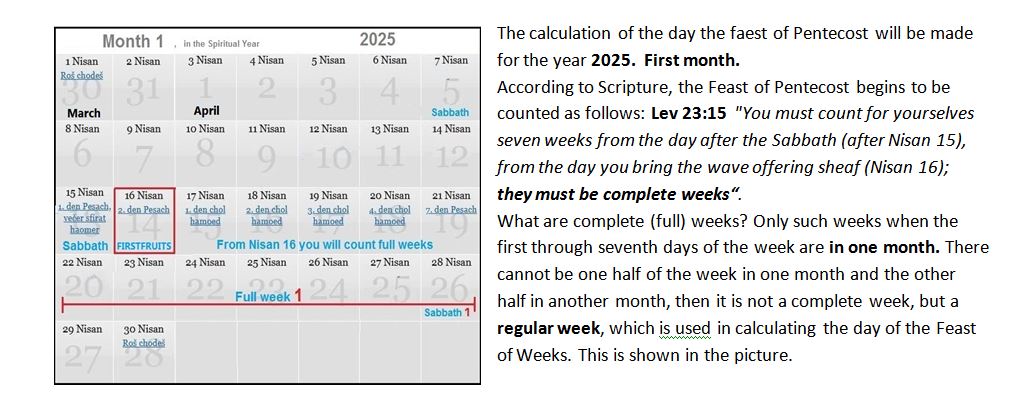
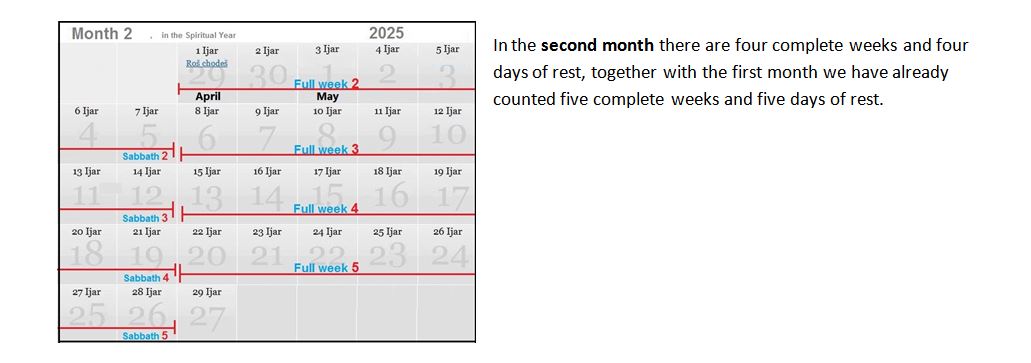
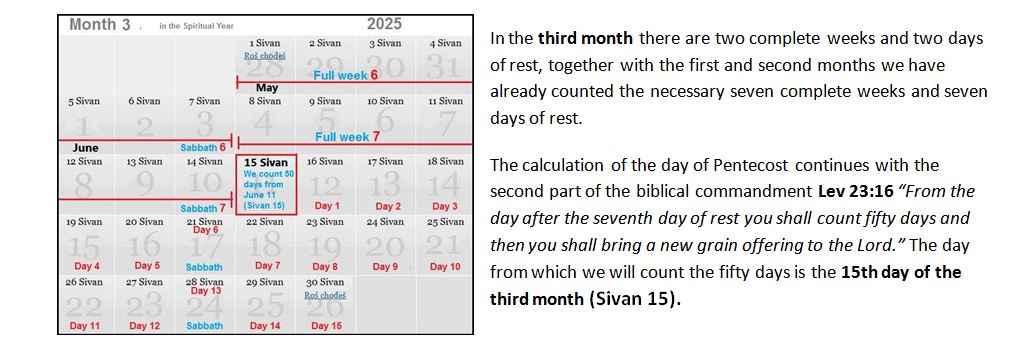
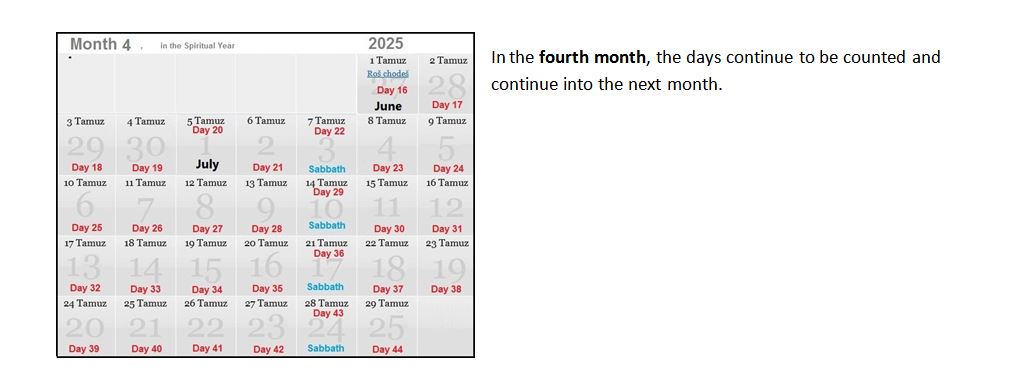
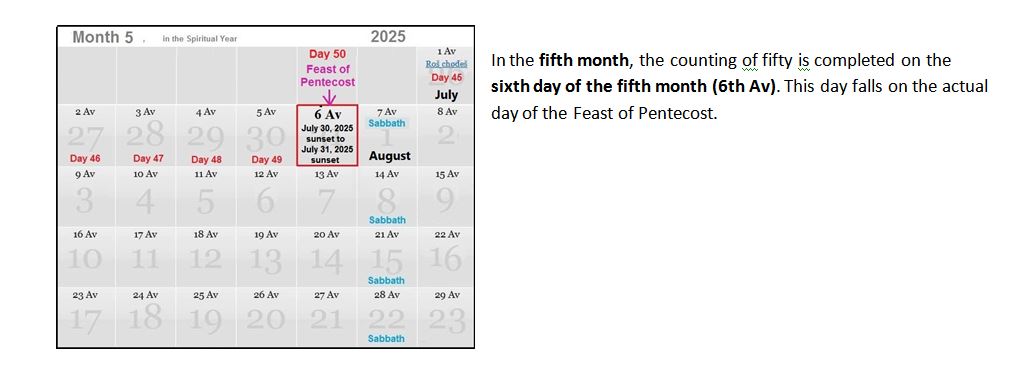
First, let's look at when and how the Feast of Pentecost is counted. For clarity, I will use pictures of a calendar, which will show the months to which the calculation of the feast applies. We know that originally in Israel the names of days and months were not used, just as the days of creation were not named. The first to the seventh day. The seventh day was then established by God as a day of rest. It began with the first month and the first day (now we call it Nisan 1). The seventh day was always counted in each month and the day of rest fell on it (today is Sabbath).
In Lev 23:3, in Ex 34:21 it is written: „Six days thou shalt work, but on the seventh day thou shalt rest“. Today’s calendars do not respect this Word of God at all. As an example, the first day of a new month begins on Wednesday, and the day of rest is then celebrated on the fourth day of that month. This is completely outside the teachings of Scripture. Therefore, I have adjusted the calendar to meet the biblical requirements for the day of rest. According to Lev 23:15,16, for each picture of the month I will clearly explain how the given month fits into the biblical calculation of the feast of Pentecost.
That this calculation is in harmony with Scripture is confirmed by the fact that after leaving Egypt on Nisan 15, the Israelites arrived at Mount Sinai on exactly the same day as we calculated in the first part of the calculation of the Pentecost date of Sivan 15. In Ex 19:1,2 it is written: “In the third month, when the children of Israel were gone out of the land of Egypt, the same day they came into the wilderness of Sinai. They had departed from Rephidim, and were come into the wilderness of Sinai, and pitched in the wilderness; and Israel pitched there before the mountain” (Sinai). So they arrived at Mount Sinai on Sivan 15.
Thus, the feast of Pentecost is connected in Scripture with the journey of Israel and with the events that took place at Mount Sinai. The Jews journeyed from Egypt to Mount Sinai for two months. Why did God lead them through the pillar of cloud and fire for exactly two months? I believe that there is a foreshadowing of the two thousand years of the journey of the church, which the Lord is now leading, through the cloud - His glory (anointing) and through the fire - purification (sanctification). The second part of the calculation of the day of Pentecost, that is, the counting of fifty days from the 15th of Sivan, may mean that the fiftieth day is a day of grace for the waiting church just as the fiftieth year is a year of grace.
In the second part of the calculation of the day of Pentecost, 50 days are counted. From Scripture we know that the events on Mount Sinai from the beginning to the first return of Moses from the mountain to the camp also lasted 50 days. God's actions on Mount Sinai were accompanied by supernatural manifestations. In the book of Exodus 19:10,11,16,19 it is written: “10 The Lord said to Moses, Go to the people and sanctify them today and tomorrow. Let them wash their clothes 11 and be ready against the third day, for on the third day the Lord will come down on Mount Sinai in the sight of all the people. 16 On the third day, when morning came, there were thunders and lightnings and a thick cloud on the mountain, and a very loud sound of a ram’s horn. All the people in the camp trembled. 19 As the sound of the ram’s horn grew louder and louder, Moses spoke, and God answered him with a loud voice.” Before Moses was called by God to go up the mountain and receive the tablets of the law, other people were called by God to the mountain to have fellowship with Him. After the above supernatural manifestations of God, not only Moses but also Aaron, Nadab and Abihu and seventy of the elders of Israel were called up to the mountain. Nowhere else in the Bible do we find people seeing God face to face, even eating with Him and not dying. I believe this is a type of the Lamb’s supper with the church, caught up into heaven. In Ex 24:9-11, where it is written: “9 Then Moses went up, and Aaron, Nadab and Abihu and seventy of the elders of Israel 10 and they saw the God of Israel, and under his feet there was something like a pavement of sapphire stone, as clear as the sky itself. 11 But against the chief of the children of Israel he did not lay a hand; for they saw God, and did eat and drink.”
Nowhere else in the Bible are such intense supernatural physical manifestations of God’s majesty recorded. God’s action on Mount Sinai was manifested through thunder, lightning, a great cloud, a very loud sound of a ram’s horn, and the voice of God. When the Holy Spirit was sent down at Pentecost, it was only a foretaste of the manifestations, because the events of Pentecost in Acts 2 were not personally fulfilled by the Lord Jesus. Therefore, only the first two manifestations mentioned in Ex 19:16 took place there, namely thunder (Acts 2: a sound was heard) and lightning (Acts 2: tongues of fire). Other supernatural manifestations from Mount Sinai mentioned in Ex 19:19 are waiting to be fulfilled, they are the trumpet blast and the loud voice of God. On Mount Sinai, these are the first supernatural manifestations, in Acts 2, some of the manifestations were fulfilled at Pentecost, and at the end, at the rapture, they will be the last unfulfilled supernatural manifestations. If Scripture speaks of the last trumpet, it logically had to be the first. It cannot be the last by itself without the previous one.
The New Testament describes the occasion when the final supernatural sound of the trumpet and the voice of the archangel will be heard.
1 Cor 15:51-52 “ 51 Behold, I tell you a mystery: We shall not all sleep, but we shall all be changed, 52 in a moment, in the twinkling of an eye, at the last trump. For the trumpet will sound, and the dead will be raised incorruptible, and we shall be changed.“
1 Thess 4:16-17 “16 For the Lord himself shall descend from heaven with a shout, with the voice of the archangel, and with the trump of God: and the dead in Christ shall rise first. 17 Then we which are alive and remain shall be caught up together with them in the clouds, to meet the Lord in the air: and so shall we ever be with the Lord.”
The connection between the events on Mount Sinai and the events of Pentecost is also confirmed in the events that took place on the fiftieth day, when Moses came down from the mountain to the camp and saw the sinful behavior of God's people there. God's punishment for this behavior was that three thousand people died on that fiftieth day. It also happened that Moses broke the stone tablets with the Ten Commandments from God. At Pentecost in Acts 2, three thousand people were saved during the first sermon after the outpouring of the Holy Spirit. These two identical numerical values are God's word. By Moses breaking the tablets of the law, it was prophetically shown that in the future, on the day of Pentecost, when the Holy Spirit was poured out, the Old Testament would be replaced by the New Covenant at the birth of the church.
It is also an interesting fact that the disciples had to wait much longer for the outpouring of the Spirit than is generally reported in the church. Today's church speaks of ten days after Jesus' ascension. However, this does not correspond to reality and the disciples had to wait at least 50 days. It is clear that they could not just be in the upper room all the time, but had to do ordinary things, buy food, etc. It is clear from the Scriptures that Jesus commanded them to be in Jerusalem until the outpouring of the Spirit of God, the disciples were not in the upper room most of the time, but mostly stayed in the temple. This is recorded in Luke 24:49-53: “49 And behold, I send the promise of my Father upon you. But tarry ye in the city of Jerusalem, until ye be endued with power from on high. 50 Then he led them out as far as Bethany: and lifting up his hands he blessed them. 51 And it came to pass, while he blessed them, that he parted from them, and was carried up into heaven. 52 And they worshipped him, and returned to Jerusalem with great joy, 53 And were continually in the temple, praising and glorifying God.” The fact that they were all gathered in the upper room on the day of Pentecost indicates the fact that they must have had a revelation that the expected event would take place on the day of Pentecost. Also, it is much better to wait when the specific day of the expected event is revealed. The same is true of the rapture. Another thing is that unlike the people at Mount Sinai who could not wait for God’s promise even for fifty days, the 120 disciples showed their faithfulness to God’s command and were able to wait for the Holy Spirit for those fifty days. I think that their faithfulness made it possible for this event of Pentecost to happen.
We know that the fiftieth year is declared in the Scriptures to be a year of grace. In Lev 25:10 it is written: “And you shall sanctify the fiftieth year, even one year. And you shall proclaim liberty throughout the land to all the inhabitants of it; it shall be a jubilee for you. And you shall return every man to his possession; yes, you shall return every man to his family.” On the feast of Pentecost in Acts 2, the Holy Spirit was poured out on the fiftieth day, and God’s saving grace was given to people of all nations through the work of the Lord Jesus. At Pentecost, which we are now awaiting, on the fiftieth day of the feast of Pentecost, the most amazing day of God's grace can be expected, and that is the rapture of God's people into heavenly dwellings.
The Church has been deceived into celebrating Pentecost on a completely different day than it actually is. It does not know the correct date of the feast and logically does not expect anything in this summer season. Perhaps this is captured in 1 Thessalonians 5:4: “But you, brothers, are not in darkness, so that that day should surprise you.” I do not know of any other day that has been so hidden from the Church. No one cares that the new wine cannot be in Israel in the spring. No one cares that full weeks are to be counted in calculating the day of Pentecost, as we have discussed, but they are still counted normally. Some already perceive that the feast of Pentecost must be in the middle of summer, but they rename the biblical feast of Pentecost the feast of new wine, and this is only because the disciples were supposed to be drunk with new wine. They no longer consider that the Bible itself calls this feast day Pentecost Acts 2:1: “And when the fiftieth day was fully come, they were all with one accord in one place.” Pentecost is a Greek word meaning "fiftieth."
Since the feast of Pentecost falls every year in late July - early August, it is logical that when this period is hidden from the church, there is a great danger that Christians will miss this period in their anticipation. At this summer time, most people are already looking forward to the feast of Rosh Hashanah and are no longer expecting or preparing for the rapture of the church. This period is also dangerous because people have other priorities - vacations, rest time, tourism, a pleasant time of year, etc.
In order to understand this teaching well, it is necessary to read Part 1 of the teaching.
The above lesson can also be viewed on video. The video is in Czech, but if you use automatic translation into English, it will be easy to understand. Automatic translation cannot be set on a mobile phone, but only on a laptop or computer.
Here is the link to the mentioned video:
https://www.youtube.com/watch?v=qt_dKv2RH-0
Petr
Maran atha