THE FEAST OF NEW WINE (TRUE
PENTECOST)
When the day of Pentecost had come the Holy Spirit came to indwell the disciples permanently. The disciples began to speak in the foreign languages of those around them. They marvelled and said, “How is it we hear these Galileans speak in our own native languages?”
Nisan 16 to Nisan 26 = 10 days + 50 days to Shavuot (New Wheat) = 60 days to Mt. Sinai. Another 50 days at Mt Sinai to the Feast of New Wine event.
AS A RAPTURE HIGH WATCH TIME 2024, 2025, 2026
First Compilation
by Allan A., June 2024
Summary of the Sanctified Proposal or Theory for your
Review and Discernment
-
Man has been given 6,000 years of fallen history and then
1,000 years with the King of Kings reigning from Jerusalem –
God created in 6 days and rested on the 7th day.
- It is proposed that there were 4,000 solar years before the crucifixion of Jesus and there will be 2,000 solar years after to the physical return of Christ to reign and rule from Jerusalem (Revelation chapter 19).
-
The Crucifixion date is anywhere from 30 to 33 A.D. therefore we can calculate a “Rapture Zone” for the end of the Church Age. By adding 2,000 solar years less the 7-year tribulation (Daniel’s 70th week, Revelation chapters 6-19) the calculation gives a year range of 2023, 2024, 2025 or 2026 as the Rapture Year?
See my supplemental information at the bottom as to why the 32
AD (Sir Robert Anderson) versus 33 AD (Harold W. Hoehner) is
the better supported crucifixion year.
- It is proposed that the traditional view of Pentecost being on the Feast of Weeks 50 days after Passover in one’s view is incorrect. True Pentecost occurred another 50 days after this at the Feast of New Wine and the end of the wheat harvest. The scene in Acts chapter 2 seems to support this. Acts chapter 2 references a query about the disciples being drunk with New Wine in which Peter replies that it is not yet the third hour. At the Feast of New Wine, the priest would at the third hour make a New Wine offering before anyone could drink the New Wine. Those in attendance at this event are identified as “dwelling in Jerusalem”. This would be different from the Feast of Weeks or Shavuot where people from all over the known world were required to come to Jerusalem. Interesting?
-
If the above proposal is true then the question becomes, “When is the Feast of New Wine” for 2024, 2025 and 2026?” A second question is “If the bride of Christ (the born-again Church) was started on True Pentecost in the Crucifixion year would it make sense for the Groom (Christ) to return for his Bride on the Feast of New Wine in 2024, 2025 or 2026?” Are you getting excited!! Boaz and Ruth were married at this time (see the book of Ruth). Boaz and Ruth are thought to be a picture of Christ and the born-again church?
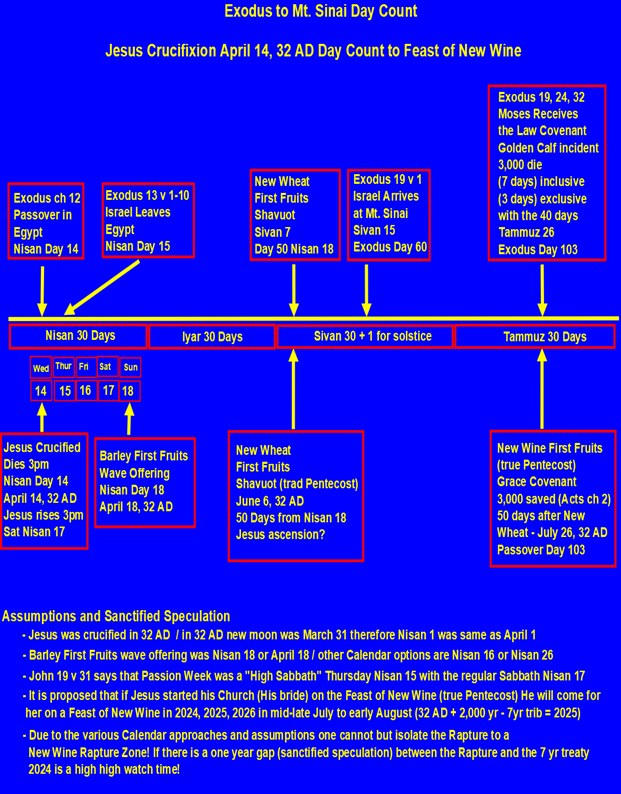
- The original Passover where Israel left Egypt was Exodus to Mt. Sinai 60 days (left Egypt on Nisan 15 arrived at Mt. Sinai in the third month Sivan 15) + 3 days preparation + 7 days Moses and Elders meet with God + 40 days and nights Moses was in the Mount with God = 110 days. (Exodus chapter 12, Exodus 13 v 1-10, Exodus 16 v 1, Exodus 19 v 1, Exodus 19 v 10-11, Exodus 24 v 13-18, Exodus 31 v 18, Exodus 32 v 28, Leviticus chapter 23) Some view the 3 days and the 7 days as inclusive to the 40 days therefore their calculation uses only 100 days. Others view the 3 days as exclusive and the 7 days as inclusive for a total of 103 days.
- This brings us to the difficult area of arriving at a solid date for the end of the wheat harvest and the Feast of New Wine. My current conclusion is that it is somewhere mid-July to early August each year. My Feast of New Wine Rapture Zone!
The following chart presents the Exodus to Mt. Sinai journey
with the 103-day assumptions. It also includes the 32 AD
crucifixion year as a 103-day parallel to the above. This will
give you a visual idea of the timelines one is proposing. A
similar timeline is being proposed for the Rapture at the
Feast of New Wine in 2024, 2025 or 2026.
Therefore, it is thought that the Law covenant with God the
Father and the nation of Israel happened on the same day as
the Feast of New Wine or true Pentecost. In the Law covenant
3,000 perished due to the Golden Calf incident but in the
Grace covenant at true Pentecost 3,000 were saved on that day.
See the picture!
Dating Complications and Difficulties with the Various
Methods used
- After a more intensive look at the methods for determining the first month (springtime) of the Israel calendar (Nisan/Abib) it is my opinion that a general date for the Feast of New Wine can be arrived at, but an exact day would be difficult unless further enlightenment is received.
- The problem is that depending upon the criteria you use to start the first month of the Israeli year (Nisan) every feast day and special day flows from the Nisan 1 date, Passover is Nisan 14, Feast of Unleavened Bread is Nisan 15-21, Shavuot is 50 days later, Feast of New Wine is 50 days after that. There is also the issue of the date of the First Fruits Barley wave offering. Currently calendars are using at least three dates I am aware of Nisan 16, Nisan 18, or Nisan 26. Shavuot is calculated 50 days inclusive from this date.
- The starting point of the year can be based upon Solar or Lunar assumptions or a combination. The Solar calendar (364 days) uses the Spring Equinox then a day near that is chosen as Nisan 1. The Lunar calendar uses the Spring Equinox as an anchor but then chooses the nearest “Sliver of the New Moon” as Nisan 1. The Lunar calendar has only 354 days a year, short by about 11 days, from the actual solar year of 365.24xx. It must then insert a 13th month into the calendar every 2 or 3 years. Some also add the importance of observing the condition of the barley crop before you declare Nisan 1. You can see where the uncertainty develops for an exact day for the Feast of New Wine! Of course, this then introduces a rapture date zone!
- The Solar calendar due to it being 4 quarters of 91 days or 364 days short by only 1.25 days (less human intervention) seems good but it has its flaws also. With its Spring Equinox starting point (March 20th) Nisan 14 can never be much more than the first few days of April which is a problem as your study will show! The famous book “The Coming Prince” by Sir Robert Anderson in his exposition of the 70 weeks of Daniel has Jesus entering Jerusalem on the foal of a donkey on April 6th, 32 A.D. ergo Passover becomes around April 10th if he is correct? A good week later than what the solar calendar would calculate.
- The Lunar calendar when adding their 13th month leap year can push Passover and the First Fruits Barley wave offering well into the harvesting of the barley instead of the start so that becomes a problem. The celebration is coming too late in the spring?
- So, what has my approach been? My approach is to lay out the different calendars below for your review and understanding and show where the Feast of New Wine is placed from each calendar. This is where my current conclusion (which could be wrong – see Torah Calendar) is a mid-July to early August time period is derived from. An exciting time period for each of the next 3 years!
- So, my write up here is a definite work in progress. Definitely need more study on what different proponents of each calendar are saying. If there is time (June 2024 already) I will try to update for new knowledge and discernment. I have done a calibration to the Exodus to Mt. Sinai day count as I believe this is a picture of our current Passover to Feast of New Wine time periods. I have as yet not connected Astrological or Jubilee information to my study as I am not very learned in these areas as yet. I have been reading the online dating arguments from the Solar and Lunar dating groups. I am reviewing why some groups use the “sliver of the new moon” sighting before or after the spring equinox to pinpoint Nisan 1.
- I have gained some knowledge on which New Moon is selected around the Spring Equinox. If the New Moon that occurs prior to the Spring Equinox will become a full moon after the Spring Equinox, then this becomes the Nisan month. If not, then the New Moon after the Spring Equinox becomes the Nisan month. This is why “The Torah Calendar” uses the New Moon prior to the Spring Equinox as the start of Nisan month.
Calendar Summary for the Feast of New Wine Rapture High
Watch Times
I now have reviewed 4 calendars, 1 based upon the solar year
(Essene) and 3 based upon the lunar cycle with leap months
added from time to time. I have also made an adjusted Essene
solar calendar for a total of 5 to review as well as the
writings of Luis B. Vega. The Chabad and HebCal lunar
calendars are basically the same with their Feast of New Wine
dates.
The Torah lunar calendar differs due to adding a leap month in
2025 instead of 2024. The Torah lunar calendar Feast of New
Wine dates are basically the same as the Chabad and HebCal for
2025 and 2026. The end of the wheat harvest in Israel is
usually completed by around mid-July and coincides with the
Feast of New Wine.
High Watch Days are summarized in the table below from 5
different calendars as well as the studies by Luis B. Vega.
Details for each calendar are shown further down the document.
There is a link down at the bottom for the extensive studies
and developed theory by Luis B. Vega.
His research covers Astronomy, Archaeology, Historical and
Biblical materials over many years. Everything is converging
in July depending on when you start the first month Nisan 1,
where you place the Barley Wave Offering of First Fruits and
if you use a Solar or Lunar based calendar with certain
adjustments!
|
Feast of
New Wine Dates
|
Feast of
New Wine Dates
|
Feast of
New Wine Dates
|
Feast of New Wine Dates
|
|
Year
|
2024
|
2025
|
2026
|
|
Adjusted Essene Calendar- Omer count Nisan 18 Sunday
(Exodus 103 days)
|
Sunday July 14 (Tammuz 25)
|
Sunday July 13 (Tammuz 25)
|
Sunday July 12 (Tammuz 25)
|
|
Essene Calendar – Omer count Nisan 26 (Exodus 110
days)
|
Sunday July 21 (Av 3)
|
Sunday July 20 (Av 3)
|
Sunday July 19 (Av 3)
|
|
Chabad Calendar – Omer count Nisan 16 - added Adar II
in 2024 (Exodus 100 days)
|
Wednesday July 31 (Tammuz 25)
|
Monday July 21 (Tammuz 25)
|
Friday July 10 (Tammuz 25)
|
|
HebCal Calendar – Omer count Nisan 16 -added Adar II
in 2024 (Exodus 100 days)
|
Wednesday July 31 (Tammuz 25)
|
Monday July 21 (Tammuz 25)
|
Friday July 10 (Tammuz 25)
|
|
Torah Calendar – Omer count Nisan 16 - added Adar II
in 2025 (Exodus 100 days)
|
Thursday July 4 (Tammuz 27)
|
Wednesday July 23 (Tammuz 27)
|
Monday July 13 (Tammuz 27)
|
|
Luis B. Vega – Crucifixion 32 A.D. – Passover
Wednesday April 14, 32 A.D. – 100 days to the Feast of
New Wine
|
July 23
|
July 23
|
July 23
|
|
Chabad Calendar – Omer count Nisan 26 - added Adar II
in 2024 (Exodus 110 days)
|
Tuesday August 10
(Av 6)
|
Tuesday August 10
(Av 6)
|
Tuesday August 10
(Av 6)
|
Solar (sun) Calendar Dead Sea Scrolls - Essenes
Solar (sun) Calendar Dead Sea Scrolls – Essenes
The Essenes were a sect of Judaism similar to the Pharisees
and the Sadducees which existed in the 2nd century BC to
the 1st century AD. Their main headquarters were the Qumran
area near the Dead Sea. They considered themselves the remnant
of true Judaism. From the Dead Sea Scrolls it was discovered
that they observed three 50-day periods after Passover. The
first was the Feast of New Wheat (Shavuot –traditionally
linked to Pentecost), the next 50 days was the Feast of New
Wine and the third 50 days was the Feast of New Oil.
This brought to light the 2 minor feasts of New Wine and New
Oil. Based upon the reading of Acts chapter 2 it is proposed
that Pentecost actually occurred on the Feast of New Wine not
on the traditional view of the Feast of New Wheat (Shavuot).
See further discussion on the Acts chapter 2 Pentecost event
below. Based upon the Dead Sea Scrolls Essene Solar (Sun))
Calendar – there was 52 weeks of 7 days, 4 days for 2
solstice/2 equinox for a total of 364 days (4 quarters of 91
days), then added an extra week every 7 years and also 2 weeks
on certain years to account for the 1.25 days under the true
solar year of 365.24xx days.
The spring month of Nisan Is considered the 1st month of the
year. Nisan 1 was always the closest Wednesday to the Spring
Equinox. Their reasoning was that the Sun, Moon and Stars were
created on the 4th day, a Wednesday. Nisan 14 is then always
on a Tuesday. The week of Unleavened Bread was always from
Wednesday Nisan 15 to Tuesday Nisan 21. First Fruits is always
on Sunday, Nisan 26.
2024 Passover to the Feast of New Wine is 110 days comparable
to the Exodus to Mt. Sinai day count. Exodus to Mt. Sinai 60
days (left Egypt on Nisan 15 arrived at Mt. Sinai in the third
month Sivan 15) + 3 days preparation + 7 days Moses and
Leaders meet with God + 40 days and nights Moses was in the
Mount with God = 110 days. This is provided you do not use any
of the 3 or 7 days as inclusive of the 40 days.
Essene Solar Calendar
|
Year
|
2024
|
2025
|
2026
|
|
Spring Equinox
|
March 20
|
March 20
|
March 20
|
|
Closest Wednesday to the Spring Equinox
|
March 20 (Nisan 1)
|
March 19 (Nisan 1)
|
March 18 (Nisan 1)
|
|
New Moon – Not Used for Passover Calculation
|
April 9 Chabad/HebCal March 12 –Torah Cal
|
March 30
|
March 19
|
|
Passover
|
April 2 (Nisan 14)
|
April 1 (Nisan 14)
|
March 31 (Nisan 14)
|
|
Feast of Unleavened Bread
|
April 3-9 (Nisan 15-21)
|
April 2-8 (Nisan 15-21)
|
April 1-7 (Nisan 15-21)
|
|
First Fruits – Barley wave offering – Omer count
starts 50 days
|
April 14
(Always Nisan 26)
|
April 13
(Always Nisan 26)
|
April 12
(Always Nisan 26)
|
|
Shavuot – New Wheat offering – 1st 50 days Jesus’
ascension?
|
Sunday June 2 (Sivan 15)
|
Sunday June 1 (Sivan 15)
|
Sunday May 31 (Sivan 15)
|
|
New Wine – Acts ch 2 True Pentecost 2nd 50 days
Boaz and Ruth picture Christ and the born-again
Church?
|
Sunday July 21 (Av 3)
High Watch Rapture Day
|
Sunday July 20 (Av 3)
High Watch Rapture Day
|
Sunday July 19 (Av 3)
High Watch Rapture
Day
|
|
New Oil – 3rd 50 days
|
Sunday Sept 8 (Elul 22)
|
Sunday Sept 7 (Elul 22)
|
Sunday Sept 6 (Elul 22)
|
|
Rosh Hashanah – Trumpets/the Unknown day
|
Sept 18 (Tishri 1)
|
Sept 17 (Tishri 1)
|
Sept 16 (Tishri 1)
|
|
Day of Atonement
|
Sept 27 (Tishri 10)
|
Sept 26 (Tishri 10)
|
Sept 25 (Tishri 10)
|
|
Feast of Tabernacles – 7days or Feast of Ingathering
(Exodus 34 v 22)
|
Oct 2-8 (Tishri 15-21)
|
Oct 1-7 (Tishri 15-21)
|
Sept 30-Oct 6 (Tishri 15-21)
|
|
Hanukkah – 8 days
|
Dec 11-18 (Kislev 25 start)
|
Dec 10-17 (Kislev 25 start)
|
Dec 9-16 (Kislev 25 start)
|
Description of the Events of Acts chapter 2
When the day of Pentecost had come the Holy Spirit came to indwell the disciples permanently. The disciples began to speak in the foreign languages of those around them. They marvelled and said, “How is it we hear these Galileans speak in our own native languages?”
Some said that the disciples were drunk with “New Wine”! But
Peter countered that idea by saying that it was not even the
third hour of the day yet!
This comment by Peter has special meaning when we look at the
Feast of New Wine. In the Feast of New Wine no one was allowed
to drink the new wine until the priests had offered it at the
third hour of the day.
Those in attendance at this event are identified as “dwelling
in Jerusalem”. This would be different from the Feast of Weeks
or Shavuot where people from all over the known world were
required to come to Jerusalem. Interesting?
Hence, strong clues that Pentecost was actually 50 days after
Shavuot (the traditional Pentecost date). If the true
Pentecost is actually on the second 50 count and on the Feast
of New Wine, then it links to the marriage of Boaz and Ruth in
the book of Ruth.
For Boaz and Ruth his Gentile bride were married at the end of
the wheat harvest and the time of the New Wine! This marriage
event has long been linked to Christ and his bride the
born-again Church! Interesting to say the least?
Chabad Lunar (moon) Calendar
>From www.chabad.org
Chabad Lunar (moon) Calendar
Based on Lunar (moon) Calendar – Since the sum of 12 lunar
months (354 days) is short of the solar year by about 11 days
there is a leap month added every 2 or 3 years. Traditional
Judaism from the 4th century onwards uses the Hillel II 19
Year Cycle adding a leap month in years 3, 6, 8, 11, 14, 17,
19 (Meton a Greek Scholar from Athens had developed this
Metonic Cycle in 432 BC). Leap month is usually in Feb/March
(Adar) and is named Adar 2. The intent is to keep the Passover
as a spring observance but requires a lot of human input to
keep it in synch with spring.
2024 Passover to the Feast of New Wine is 100 days comparable
to the Exodus to Mt. Sinai day count if adjusted. Exodus to
Mt. Sinai 60 days (left Egypt on Nisan 15 arrived at Mt. Sinai
in the third month Sivan 15) + 3 days preparation + 7 days
Moses and Leaders meet with God + 40 days and nights Moses was
in the Mount with God = 110 days. The 100 days will line up if
you treat the 3 days and the 7 days as inclusive within the 40
days.
Chabad Lunar (moon) Calendar
|
Year
|
2024
|
2025
|
2026
|
|
Spring Equinox
|
March 20 (10 Adar II)
|
March 20 (Adar 20)
|
March 20 (Nisan 2)
|
|
New Moon
|
April 9 (Nisan 1)
|
March 30 (Nisan 1)
|
March 19 (Nisan 1)
|
|
Passover
|
April 22 (Nisan 14)
|
April 12 (Nisan 14)
|
April 1 (Nisan 14)
|
|
Feast of Unleavened Bread
|
April 23-29th
|
April 13-19th
|
April 2-8
|
|
First Fruits – Barley wave offering – Jesus’
resurrection
|
Wednesday April 24 (Nisan 16)
|
Monday April 14 (Nisan 16)
|
Friday April 3 (Nisan 16)
|
|
Shavuot – New Wheat offering – 1st 50 days Jesus
Ascension?
|
Wednesday June 12 (Sivan6)
|
Monday June 2 (Sivan 6)
|
Friday May 22 (Sivan 6)
|
|
New Wine – Acts ch 2 True Pentecost 2nd 50 days
Boaz and Ruth picture Christ and the born-again
Church?
|
Wednesday July 31 (Tammuz 25)
High Watch Rapture Day
|
Monday July 21 (Tammuz 25)
High Watch Rapture Day
|
Friday July 10 (Tammuz 25)
High Watch Rapture
Day
|
|
New Oil – 3rd 50 days
|
Wednesday Sept 18 (Elul 15)
|
Monday Sept 8 (Elul 15)
|
Friday Aug 28 (Elul 15)
|
|
Rosh Hashanah – Trumpets/the Unknown day
|
Oct 3-4 (Tishri 1)
|
Sept 23-24 (Tishri 1)
|
Sept 12-13 (Tishri 1)
|
|
Day of Atonement
|
Oct 12 (Tishri 10)
|
Oct 2 (Tishri 10)
|
Sept 21 (Tishri 10)
|
|
Feast of Tabernacles – 7 days or Feast of Ingathering
(Exodus 34 v 22)
|
Oct 16-22 (Tishri 14-20)
|
Oct 6-12 (Tishri 14-20)
|
Sept 24-Oct 1 (Tishri 14-20)
|
|
Hanukkah – 8 days
|
Dec 25, 2024, to Jan 2 2025
|
Dec 14-22
|
Dec 4-12
|
Essene Solar Calendar adjusted for around March 20 Spring
Equinox each year as Nisan 1 and the First Fruits wave
offering being Nisan 18 (first day after regular Sabbath) not
Nisan 26 – First Fruits, New Wheat, New Wine and New Oil all
on 1st day of the week or Sunday.
A short summary of Passion Week and the Crucifixion of
Jesus
Remember that a day on the Jewish calendar goes from 6 pm the
prior evening to 6 pm the next day. Leviticus chapter 23 gives
the guidelines for the Passover and the Feast of Unleavened
Bread. The Passover lamb was slain on Nisan 14 at 3pm and then
the Feast of Unleavened Bread was from Nisan 15-21.
13th day of Nisan (Tuesday)
– this day is called the preparation day for Passover – the
actual Passover meal is eaten after 6 pm so therefore eaten at
the start of Nisan 14 – Jesus ate the Passover meal with His
disciples in the Upper Room this evening.
14th day of Nisan (Wednesday)
– the Passover lambs were killed at 3pm Wednesday afternoon -
Jesus after his sham trial was crucified this day and said “it
is finished” at 3 pm – Jesus was taken down and buried before
6pm Wednesday night because the High Sabbath started at 6 pm
Wednesday evening (John 19 v 31).
15th day of Nisan (Thursday)
– this was the 1st day of the Feast of Unleavened Bread
and known as the “High Sabbath”.
16th day of Nisan
(Friday) – this was the 2nd day of the Feast of
Unleavened bread – some have considered this as the “morrow
after the Sabbath” but we will use Nisan 18.
17th day of Nisan (Saturday)
– this was the regular Sabbath – Jesus rose from the dead on 3
pm this afternoon – this equated to 3 nights and 3 days in the
grave.
18th day of Nisan (Sunday)
– the first day of the week (the morrow after the regular
Sabbath interpreted) where believers would meet for prayer,
study and the bread and wine for remembrance of the Passion of
Jesus – First Fruits wave offering by the Priest.
John 19 v 31
31 The Jews therefore, because it was the preparation, that
the bodies should not remain upon the cross on the Sabbath
day, (for that Sabbath day was a high day,) besought Pilate
that their legs might be broken, and that they might be
taken away.
John 2 v 19
Jesus answered and said unto them, Destroy this temple, and
in three days I will raise it up. (sign of Jonah also).
Matthew 12 v 38-40
38 Then certain of the scribes and of the Pharisees
answered, saying, Master, we would see a sign from thee.
39 But he answered and said unto them, An evil and
adulterous generation seeketh after a sign; and there shall
no sign be given to it, but the sign of the prophet Jonas:
40 For as Jonas was three days and three nights in the
whale's belly; so, shall the Son of man be three days and
three nights in the heart of the earth.
1 Corinthians 15 v 20
20 But now is Christ risen
from the dead and become the first fruits of them that
slept.
In Leviticus 23 v 5-8, Nisan 15 is identified as a holy
convocation (a high Sabbath) and the start of the Feast of
Unleavened Bread for 7 days, then the 8th day is another
holy convocation. Leviticus 23 v 10-14 identifies the “sheaf
offering of barley” as a wave offering performed by the priest
(Feast of First Fruits) on the first day after the regular
Sabbath (Nisan 18 an interpretation).
So, there is disagreement about the Feast of First Fruits as
to what day the “morrow after the Sabbath” is referring to in
Leviticus 23 v 10-11? There are a number of interpretations
currently being used. The Chabad calendar identifies this day
as Nisan 16 the second day of the Feast of Unleavened Bread or
one day after the holy convocation of Nisan 15.
The Essene calendar identifies it as the day after the Sabbath
Saturday of Nisan25 or Sunday Nisan 26. The third
interpretation is resurrection Sunday or Nisan 18 or a day
after the regular Sabbath. Though I could be wrong I am going
to go with Nisan 18 for a couple of reasons. In 1 Corinthians
15 v 20 it says Christ is our “First Fruits” of those who rise
from the dead.
In John 2 v 19 Jesus said to the Pharisees “destroy this
temple and in three days I will raise it up. So, I link the
Feast of First Fruits right at the Resurrection event, rather
than a date much later such as Nisan 26. I adjusted the
original Essene calendar to add days for the 2 solstices and 2
spring equinoxes. The months of Sivan, Tishri, Kislev and Adar
have 31 days.
The original Essene calendar chose Nisan 1 as the closest
Wednesday to the Spring Equinox. They reasoned that the Sun,
Moon and Stars were created on Creation weekday 4 (Wednesday)
for signs and seasons. With this start date then Nisan 14
would always be a Tuesday.
My thoughts (just sanctified speculation) were to use the
nearest Thursday (Creation week, day 5) to the Spring Equinox
as this was the first day that the Sun, Moon and Stars were
fully functioning. This would make Nisan 14 always on a
Wednesday in order to give the same days of the week as the
“Passion Week of Jesus”.
All the special days, Feast of First Fruits, New Wheat, New
Wine, and New Oil then fall on the first day of the week or
Sunday throughout the year when using Nisan 18 as the “morrow
after the Sabbath”.
2024 Passover to the Feast of New Wine is 103 days, almost
comparable to the Exodus to Mt. Sinai day count if adjusted.
Exodus to Mt. Sinai 60 days (left Egypt on Nisan 15 arrived at
Mt. Sinai in the third month Sivan 15) + 3 days preparation +
7 days Moses and Leaders meet with God + 40 days and nights
Moses was in the Mount with God = 110 days. The 103 days will
line up if you treat the 3 days exclusive and the 7 days as
inclusive within the 40 days.
Adjusted Essene Solar Calendar
|
Year
|
2024
|
2025
|
2026
|
|
Spring Equinox – add one day to prior month Adar for
31 days
|
March 20
|
March 20
|
March 20
|
|
Nisan 1 - Thursday closest to the Spring Equinox
|
March 21 (Nisan 1)
|
March 20 (Nisan 1)
|
March 19 (Nisan 1)
|
|
New Moon – Not Used for Passover Calculation
|
April 9 – Chabad/HebCal
March 12 – Torah Cal
|
March 30
|
March 19
|
|
Passover
|
Wed April 3 (Nisan 14)
|
Wed April 2 (Nisan 14)
|
Wed April 1 (Nisan 14)
|
|
Feast of Unleavened Bread
|
Thurs April 4-10 (Nisan 15-21)
|
Thurs April 3-9 (Nisan 15-21)
|
Thurs April 2-8 (Nisan 15-21)
|
|
First Fruits – Barley wave offering – Omer count
starts 49 days or 7 Sabbaths
|
Sunday April 7
(Nisan 18)
|
Sunday April 6
(Nisan 18)
|
Sunday April 5
(Nisan 18)
|
|
Shavuot 1 – New Wheat offering – 1st 50 days Jesus’
ascension?
|
Sunday May 26 (Sivan 7)
|
Sunday May 25 (Sivan 7)
|
Sunday May 24 (Sivan 7)
|
|
Shavuot 2 - New Wine – Acts ch 2 True Pentecost
2nd 50 days
Boaz and Ruth picture Christ and the born-again
Church?
|
Sunday July 14 (Tammuz 25)
High Watch Rapture Day
|
Sunday July 13 (Tammuz 25)
High Watch Rapture Day
|
Sunday July 12 (Tammuz 25)
High Watch Rapture
Day
|
|
Shavuot 3 - New Oil – 3rd 50 days
|
Sunday Sept 1 (Elul 14)
|
Sunday August 31 (Elul 14)
|
Sunday August 30 (Elul 14)
|
|
Rosh Hashanah – Trumpets/the Unknown day
|
Sept 18 (Tishri 1)
|
Sept 17 (Tishri 1)
|
Sept 16 (Tishri 1)
|
|
Day of Atonement
|
Sept 27 (Tishri 10)
|
Sept 26 (Tishri 10)
|
Sept 25 (Tishri 10)
|
|
Feast of Tabernacles – 7days or Feast of Ingathering
(Exodus 34 v 22)
|
Oct 2-8 (Tishri 15-21)
|
Oct 1-7 (Tishri 15-21)
|
Sept 30- Oct 6 (Tishri 15-21)
|
|
Hanukkah – 8 days
|
Dec 12-19 (Kislev 25 start)
|
Dec 11-18 (Kislev 25 start)
|
Dec 10-17 (Kislev 25 start)
|
The Torah Calendar
Chabad and HebCal calendars added Adar II in 2024 – Torah
Calendar added Adar II in 2025. Torah calendar uses the
“sliver of the New Moon” that occurred before the Spring
Equinox on March 12th instead of after like the Chabad
calendar which uses April 9th.
2024 Passover to the Feast of New Wine is 100days, almost
comparable to the Exodus to Mt. Sinai day count if adjusted.
Exodus to Mt. Sinai 60 days (left Egypt on Nisan 15 arrived at
Mt. Sinai in the third month Sivan 15) + 3 days preparation +
7 days Moses and Leaders meet with God + 40 days and nights
Moses was in the Mount with God = 110 days. The 100 days will
line up if you treat the 3 days and the 7 days as inclusive
within the 40 days.
|
Year
|
2024
|
2025
|
2026
|
|
Spring Equinox
|
March 20 (Nisan 9)
|
March 20 (Adar II 19)
|
March 21 (Nisan 1)
|
|
New Moon
|
Tuesday March 12 (Nisan 1)
|
Monday March 31 (Nisan 1)
|
Saturday March 21 (Nisan 1)
|
|
Passover
|
Monday March 25 (Nisan 14)
|
Sunday April 13 (Nisan 14)
|
Friday April 3 (Nisan 14)
|
|
Feast of Unleavened Bread
|
Tuesday March 26 (Nisan 15-21)
|
Monday April 14-20 (Nisan 15-21)
|
Saturday April 4-10 (Nisan 15-21)
|
|
First Fruits – Barley wave offering – Jesus’
resurrection
|
Wednesday March 27 (Nisan 16)
|
Tuesday April 15 (Nisan 16)
|
Sunday April 5
(Nisan 16)
|
|
Shavuot – New Wheat offering – 1st 50 days Jesus
Ascension?
|
Wednesday May 15 (Sivan6)
|
Tuesday June 3 (Sivan 6)
|
Sunday May 24 (Sivan 7)
|
|
New Wine – Acts ch 2 True Pentecost 2nd 50 days
Boaz and Ruth picture Christ and the born-again
Church?
|
Thursday July 4 (Tammuz 27)
High Watch Rapture Day
|
Wednesday July 23 (Tammuz 27)
High Watch Rapture Day
|
Monday July 13 (Tammuz 27)
High Watch Rapture
Day
|
|
New Oil – 3rd 50 days
|
Friday August 23 (Elul 18)
|
Thursday Sept 11 (Elul 18)
|
Tuesday Sept 1 (Elul 18)
|
|
Rosh Hashanah – Trumpets/the Unknown day
|
Sept 5 (Tishri 1)
|
Sept 24 (Tishri 1)
|
Sept 13 (Tishri 1)
|
|
Day of Atonement
|
Sept 14 (Tishri 10)
|
Oct 3 (Tishri 10)
|
Sept 22 (Tishri 10)
|
|
Feast of Tabernacles – 7 days or Feast of Ingathering
(Exodus 34 v 22)
|
Sept 19-25 (Tishri 15-21)
|
Oct 8-14 (Tishri 15-21)
|
Sept 27-Oct 3 (Tishri 15-21)
|
|
Hanukkah – 8 days
|
Nov 28 – Dec 5th (Kislev 25-30/Tevet 1-2)
|
Dec 17-24 (Kislev 25-29/Tevet 1-3)
|
Dec 6-13 (Kislev 25-29/Tevet 1-3
|
Hebrew Calendar
HebCal adds Adar II in 2024, Chabad adds Adar II in 2024,
Torah Calendar adds Adar II in 2025. The “sliver of the New
Moon” used is April 9th.
2024 Passover to the Feast of New Wine is 100 days comparable
to the Exodus to Mt. Sinai day count if adjusted. Exodus to
Mt. Sinai 60 days (left Egypt on Nisan 15 arrived at Mt. Sinai
in the third month Sivan 15) + 3 days preparation + 7 days
Moses and Leaders meet with God + 40 days and nights Moses was
in the Mount with God = 110 days. The 100 days will line up if
you treat the 3 days and the 7 days as inclusive within the 40
days.
|
Year
|
2024
|
2025
|
2026
|
|
Spring Equinox
|
March 20 (Adar II 11)
|
March 20 (Adar 21)
|
March 20 (Nisan 3)
|
|
New Moon
|
Tuesday April 9 (Nisan 1)
|
Sunday March 30 (Nisan 1)
|
Thursday March 19 (Nisan 1)
|
|
Passover
|
Monday April 22 (Nisan 14)
|
Saturday April 12 (Nisan 14)
|
Wednesday April 1 (Nisan 14)
|
|
Feast of Unleavened Bread
|
Tuesday April 23-30 (Nisan 15-22)
|
Sunday April 12-19 (Nisan 15-22)
|
Thursday April 2-9 (Nisan 15-22)
|
|
Feast of First Fruits – Barley offering – Jesus’
resurrection
|
Wednesday April 24 (Nisan 16)
|
Monday April 14 (Nisan 16)
|
Friday April 3
(Nisan 16)
|
|
Shavuot – New Wheat offering – 1st 50 days Jesus
Ascension?
|
Wednesday June 12 (Sivan6)
|
Monday June 2 (Sivan 6)
|
Friday May 22 (Sivan 6)
|
|
New Wine – Acts ch 2 True Pentecost 2nd 50 days
Boaz and Ruth picture Christ and the born-again
Church?
|
Wednesday July 31 (Tammuz 25)
High Watch Rapture Day
|
Monday July 21 (Tammuz 25)
High Watch Rapture Day
|
Friday July 10 (Tammuz 25)
High Watch Rapture
Day
|
|
New Oil – 3rd 50 days
|
Wednesday Sept 18 (Elul 15)
|
Monday Sept 18
(Elul 15)
|
Friday Aug 28 (Elul 15)
|
|
Rosh Hashanah – Trumpets/the Unknown day
|
Oct 3 (Tishri 1)
|
Sept 23 (Tishri 1)
|
Sept 12 (Tishri 1)
|
|
Day of Atonement
|
Oct 12 (Tishri 10)
|
Oct 2 (Tishri 10)
|
Sept 21 (Tishri 10)
|
|
Feast of Tabernacles – 7 days or Feast of Ingathering
(Exodus 34 v 22)
|
Oct 17-23 (Tishri 15-21)
|
Oct 7-13 (Tishri 15-21)
|
Sept 26-Oct 2 (Tishri 15-21)
|
|
Hanukkah – 8 days
|
Dec 25 – Jan2 (Kislev 25-Tevet 2)
|
Dec 14-22 (Kislev 25- Tevet 2)
|
Dec 4-12 (Kislev 25-Tevet 2)
|
Luis B. Vega Sanctified Theory on the Feast of New Wine
Date
Crucifixion date was April 14, 32 A.D. + 100 days.
For 2024, 2025 and 2026 the Date would be July 23. That is
also the start of the Astrological Leo New Year per Luis B.
Vega. Luis has decided to cut the Gordian Knot on all these
various close but conflicting calendars and just anchor the
Feast of New Wine to the Leo New Year.
Article # 950 The Exodus to Mt. Sinai day count
The Exodus to Mt. Sinai day count chart
Article # 973 Pentecost New Wine Calendar of Months and Days
Pentecost New Wine Calendar of Months and Days Chart
Luis B. Vega Article web site – a humble but leading thinker
in this area for many years
Dr. Barry Awe’s Presentation Applied to the Chabad
Calendar
Using Nisan 26 as the First Fruits Barley wave offering
instead of Nisan 16 moving the Feast of New Wine to the Friday
August 10 (Av 6). This is very near the day of many of
Israel’s calamities such as the destruction of their 2
Temples. That day would be August 13th Tishah B’Av (Av
9).
Dr. Barry Awe’s presentation is at the link below.
Nisan 16 to Nisan 26 = 10 days + 50 days to Shavuot (New Wheat) = 60 days to Mt. Sinai. Another 50 days at Mt Sinai to the Feast of New Wine event.
2024 Passover to the Feast of New Wine is 110 days comparable
to the Exodus to Mt. Sinai day count. Exodus to Mt. Sinai 60
days + 3 days preparation + 7 days Moses and Leaders meet with
God + 40 days and night that Moses was in the Mount with God =
110 days. This is provided you do not use any of the 3 or 7
days as inclusive of the 40 days.
Chabad Calendar using Nisan 26 as First Fruits
|
Year
|
2024
|
2025
|
2026
|
|
Spring Equinox
|
March 20 (10 Adar II)
|
March 20 (Adar 20)
|
March 20 (Nisan 2)
|
|
New Moon
|
April 9 (Nisan 1)
|
March 30 (Nisan 1)
|
March 19 (Nisan 1)
|
|
Passover
|
April 22 (Nisan 14)
|
April 12 (Nisan 14)
|
April 1 (Nisan 14)
|
|
Feast of Unleavened Bread
|
April 23-29th
|
April 13-19th
|
April 2-8
|
|
First Fruits – Barley wave offering – Jesus’
resurrection
|
Saturday May 4 (Nisan 26)
|
Thursday April 24 (Nisan 26)
|
Monday April 13 (Nisan 26)
|
|
Shavuot – New Wheat offering – 1st 50 days Jesus
Ascension?
|
Saturday June 22 (Sivan 16)
|
Thursday June 12 (Sivan 16)
|
Monday June 1 (Sivan 16)
|
|
New Wine – Acts ch 2 True Pentecost 2nd 50 days
Boaz and Ruth picture Christ and the born-again
Church?
|
Tuesday August 10
(Av 6)
High Watch Rapture Day
|
Thursday July 31
(Av 6)
High Watch Rapture Day
|
Monday July 20 (Av 6)
High Watch Rapture
Day
|
|
New Oil – 3rd 50 days
|
Saturday Sept 28 (Elul 25)
|
Thursday Sept 18 (Elul 25)
|
Monday Sept 7
(Elul 25)
|
|
Rosh Hashanah – Trumpets/the Unknown day
|
Oct 3-4 (Tishri 1)
|
Sept 23-24 (Tishri 1)
|
Sept 12-13 (Tishri 1)
|
|
Day of Atonement
|
Oct 12 (Tishri 10)
|
Oct 2 (Tishri 10)
|
Sept 21 (Tishri 10)
|
|
Feast of Tabernacles – 7 days or Feast of Ingathering
(Exodus 34 v 22)
|
Oct 16-22 (Tishri 14-20)
|
Oct 6-12 (Tishri 14-20)
|
Sept 24-Oct 1 (Tishri 14-20)
|
|
Hanukkah – 8 days
|
Dec 25, 2024, to Jan 2 2025
|
Dec 14-22
|
Dec 4-12
|
Sanctified Dating Discussion
We think that originally in the perfect world of Genesis
chapter 1 the solar (sun) year was 360 days. Once the earth
was destroyed in the flood in Genesis 7 v 11 (the great
fountains of the deep broke up – internal meltdown of the
earth) the number of days to circle the sun changed. It has
now settled out to be about 365.24xx days.
It is also very likely that in that perfect world of Genesis
chapter 1 the moon would have had 12 equal orbits of 30 days
(360 days) around the earth also. Of course, after the flood
we think the moon also had a change in its orbiting the earth.
It has settled out to be 29-30 days each month for a yearly
total of around 354 days. Hence Rabbinical Israel uses leap
months to account for this difference to the solar (sun) year.
The point to be made is that 1 physical year of orbit around
the Sun has varied over the last 6,000 years (we think
originally 360 days, settling out at 365.24xx days).
If the pattern of 6,000 years of fallen human history followed
by the 1,000-year millennial kingdom is true, then a solar
year is a solar year regardless of its varying length over
history. No need for special calculations to account for the 6
days God laboured and the 1 day of rest.
It is noted that the important prophetic verses in Daniel
chapter 9 v 24-27 revealing the 70 weeks of Daniel or 70 weeks
of years (i.e., 490 prophetic years) use 360 days as a year.
We see this for the last week of years (70th week of
Daniel) in Revelation chapter 6 to19. The descriptions there
show two periods of 3 and a half years consisting of 1,260
days or 42 months. So, in some prophetic circumstances God
still uses a 360-day year. It also appears in Genesis 8 v 3
that 30-day months were used prior to the flood as 5 months is
equated to 150 days.
Sanctified Rapture Zone Discussion
Too many variables in the various calendars and crucifixion
dates to be dogmatic so one should hold lightly these next
thoughts –
I would currently say a
mid July to early August Rapture on the Feast of New Wine in
one of the next 3 years is certainly one of the highest ever
watch times!
So, this brings us to what I would call a “Rapture Zone” for
the end of the Church Age. We would suppose that there would
be 4,000 solar years before the Cross of Jesus and 2,000 solar
years after the Cross of Jesus ending with the visible return
of the Lord Jesus Christ to reign from Jerusalem for 1,000
years.
The issue to narrow down the “season of his return” or “seeing
the day approaching – Hebrews 10 v 25” is complicated by
identifying the year of the crucifixion. The generally
accepted year range of the crucifixion is in the spring
Passover of 30 to 33 A.D. By adding 2,000 solar years to these
dates, it gives us a range for the Second Coming of Jesus to
Reign as 2030 to 2033 A.D. If we deduct the 70th week of
Daniel (7 years) from these dates, we get a rapture zone of
2023 to 2026 A.D. There is also the possibility of a time gap
between the Rapture and the signing of the 7-year covenant by
the Anti-Christ with the nation of Israel.
We have no clear scriptural indication as yet how long that
would be? I currently hold that it might be 1 year but that is
just sanctified speculation on my part! There is the principal
in Deuteronomy 24 v 5 of a newly married Jewish man being
exempt from going to war for one year. Perhaps this could be a
picture of Christ coming for His bride one year before the
main events in Revelation chapter 6 to 19 begin?
Deuteronomy 24 v 5 When a man hath taken a new wife, he shall
not go out to war, neither shall he be charged with any
business: but he shall be free at home one year and shall
cheer up his wife which he hath taken.
If the above is valid then the born-again Bride of Christ is
at the door of the Rapture or Harpazo to meet Christ in the
air!
There has always been sanctified speculation that the Rapture
would be on a special day (an appointed time) not a random
day. That God the Father would tell God the Son to go get his
Bride on a predetermined and special day. This would follow
Jewish Wedding traditions where the Father would decide the
day that the Son could go get his bride once all preparations
were in order (John 14 v 1-3). From the betrothal date to the
Groom going to get his Bride was traditionally about 1 year.
In the calendars presented I have highlighted in red a
significant high watch day (see the summary chart at the top)
for the Feast of New Wine or true Pentecost. It occurs at the
end of the Wheat harvest and the start of the Feast of New
Wine. Is Boaz and Ruth a picture of Christ coming for his
mostly Gentile bride? Boaz and Ruth were married at the time
of the Wheat harvest and the Feast of New Wine.
Would Christ start his Church on the New Wine Pentecost in
Acts chapter 2 and end it on the New Wine Pentecost in one of
the next three years? Jewish wedding tradition has the groom
coming for his bride at the same time or season in which the
betrothal occurred.
The various dates presented mostly place the Feast of New Wine
in mid to late July to early August and present a compelling
picture of a very high watch time for the born-again Bride of
Christ.
Therefore, we watch and wait. We occupy and warn till He
comes!
For your further study I would recommend the articles by
Luis B. Vega and the material by Ken Johnson on the Dead Sea
Scrolls.
Luis B. Vega Article web site – a humble but leading thinker
in this area for many years
Ken Johnson’s material on the Dead Sea Scrolls at
https://www.biblefacts.org.
The Torah Article referencing Numbers 18 v 12 and Deuteronomy
14 v 22 and the Essenes.
The correct order of events at the Passion Week of Jesus!
Strong defense for the Crucifixion Year being 32 AD and in
agreement with the book “The Coming Prince” by Sir Robert
Anderson versus 33 AD proposed by Harold Hoehner from Dallas
Theological Seminary in his book Chronological Aspects of the
Life of Christ published 1978. http://endtimepilgrim.org/70wks1.htm
Jewish Months to their Gregorian Equivalents – The Essenes
used 12 30-day months plus 4 days for the 2 solstice and 2
equinoxes.
|
Jewish
Month
|
Number of
Days
|
Gregorian Equivalent
|
|
Nisan (Abib)
|
30
|
March-April
|
|
Iyar
|
29
|
April-May
|
|
Sivan
|
30
|
May-June
|
|
Tammuz
|
29
|
June-July
|
|
Av
|
30
|
July-August
|
|
Elul
|
29
|
August-September
|
|
Tishri
|
30
|
September-October
|
|
Heshvan
|
29 or 30
|
October-November
|
|
Kislev
|
30 or 29
|
November-December
|
|
Tevet
|
29
|
December-January
|
|
Shevat
|
30
|
January-February
|
|
Adar
|
29 or 30
|
February-March
|
|
Adar 2 – Leap Month
|
29
|
March-April
|
|
Israel
Solstice and Equinox
|
2024
|
2025
|
2026
|
|
Spring/Vernal Equinox
|
March 20
|
March 20
|
March 20
|
|
Summer Solstice
|
June 20
|
June 21
|
June 21
|
|
Fall/Autumn Equinox
|
Sept 22
|
Sept 22
|
Sept 23
|
|
Winter Solstice
|
Dec 21
|
Dec 21
|
Dec 21
|
Scriptures for the Calendars
Leviticus 23 v 3-6 days
of work then a rest or Sabbath day
Leviticus 23 v 4-8 –
Passover is the 14th day of Nisan – Feast of Unleavened
Bread is the 15th day of Nisan for 7 days.
Leviticus 23 v 11-16 –
Wave offering by the Priest of First Fruits (Barley) on the
“morrow after the Sabbath” then the Omer count of 7 sabbaths
or 49 days and the next day the (50th day) the First Fruits
of the Wheat or Shavuot.
Scriptures for the Exodus to Mt. Sinai Day Count
Exodus ch 12 –
Nisan is the first month of the year for Israel and on Nisan
14 they would kill the Passover lamb (tradition has at 3pm)
– Nisan 15 will be the Feast of Unleavened Bread for 7 days.
Exodus ch 13 v 1-10
– Nisan 15 of the first month was the day that
Israel left Egypt.
Exodus ch 16 v 1 –
Israel arrived in the wilderness of Sin on the 15th day
of the second month (Iyar) after leaving Egypt.
Exodus ch 19 v 1 –
Israel arrives at the foot of Mt Sinai on the 15th day
of the third month (Sivan) for a total of 60 days travelling
(60-day period)
Exodus ch 19 v 10-11 –
God meets with Moses and people on the third day (3-day
period) – God introduces the 10 commandments and many
ordinances to the end of
Exodus chapter 23.
Exodus ch 24 v 13-18
– Moses and the Nobles went up into the mount
of God for 7 days then Moses spent a total of 40 days and
nights in the mount of God.
Exodus 31 v 18 –And
he gave unto Moses, when he had made an end of communing
with him upon mount Sinai, two tables of testimony, tables
of stone, written with the finger of God.
Exodus 32 –
the Golden calf incident where 3,000 perished (verse 28).
Does this day correspond with the Feast of New Wine (true
Pentecost) where 3,000 were saved in a day?
Exodus Summary has a total of 100, 103 or 110 days from the
Exodus from Egypt to Mt. Sinai and the covenant Israel made
with God. This depends on how you treat the 3 days and the 7
days whether inclusive or exclusive with the 40 days that
Moses spent in the Mount. Is the New Testament with the final
Passover crucifixion to the Feast of New Wine (true Pentecost)
a parallel with this timeline?
Supplemental Information on the Crucifixion Year
Proposals of 32 AD and 33 AD
Why the Spring of 32 AD Proposed by Sir Robert Anderson is
a Stronger Crucifixion Year than 33 AD Proposed by Harold
Hoehner
Critique of Chronological Aspects of the Life of Christ (1978)
By Harold W. Hoehner
- In Luke 3 v 1 the start of the ministry of John the Baptist is identified as the 15th year of the reign of Tiberius. Caesar Augustus had died on August 19th 14 AD. Hoehner correctly recognizes that the 15th year of Tiberius runs from August 19th 28 AD to August 18th 29 AD (chapter 2 page 36). But then Hoehner selects the start of John the Baptist’s ministry as the summer of 29 AD instead of the Late Summer/Fall of 28 AD. This bypasses year 32 AD as the crucifixion year based on his selection and the calculation forces a 33 AD crucifixion. A better selection of a Late Summer/Fall for the start John the Baptist’s ministry and the baptism of Jesus allow for a three-and-a-half-year ministry and a Wednesday crucifixion on April 14th 32 AD. This year allows for 3 days and 3 nights in the grave. (Passover killed 3pm Wed afternoon - Wed eve/Thurs day -1st day; Thurs eve/Friday – 2nd days; Friday evening/Saturday resurrection at 3pm – 3rd days which equals 3 nights and days)
- Hoehner sets aside the clear verse in Mathew 12 v 40 that the Son of Man would be 3 days and nights in the grave – verse 40 “For as Jonas was three days and three nights in the whale's belly; so, shall the Son of man be three days and three nights in the heart of the earth”. Hoehner accepts the theory that a partial day can be treated as full day and subscribes to Passover as a Friday to Sunday time period – with this assumption it is difficult to show that 3 days and nights passed – Jesus died on Friday afternoon between 3-5pm, buried before sunset and rose on the third day. He says that a Friday crucifixion has the overwhelming support of scholars throughout the history of the Church (chapter 4 page 74).
- Hoehner theorizes that because it is definitely a Friday crucifixion, he would identify what years between 26 AD and 36 AD have a new moon that puts the Nisan 14 Passover on a Friday. He finds out that this occurred on 27AD, 30 AD, 33 AD and 36 AD. (chapter 5) The year 27 AD is eliminated because it is before the 15th year of Tiberius. The year 36 AD is eliminated because the ministry of Jesus would not have lasted 6 years. The year 30 AD is eliminated because there would only have been a one-year ministry if the 15th year of Tiberius is correct. Hoehner concludes that the best fit is 33 AD as it allows for nearly a 4-year ministry and the crucifixion on the 4th Passover.
- Hoehner changes the start of the calculation of the first 69 weeks of Daniel to 444 BC from 445 BC per Sir Robert Anderson. This moves the crucifixion year to 33 AD. (Daniels 70 weeks of years Daniel 9 v 24-27). The Coming Prince by Sir Robert Anderson indicates the decree to rebuild the walls of Jerusalem by the Persian King Artaxerxes was in the month of Nisan in the 20th year of his reign. The 20th year of his reign was determined to be 445 BC.
>From this date Anderson’s calculation of the 69 weeks of
years brings one to the spring of 32 AD as the crucifixion
year. What historically occurred is that Xerxes was murdered
in July of 465 BC (see Babylonian tablet BM 32234 –
assassination dated Mordad month v, day 14, 465 BC – was late
July early August). Artaxerxes was the rightful heir but had
to depose a usurper named Artabanus with his sons. That
process took 7 months and Artaxerxes ascended the throne in
Feb 464 BC. What then becomes the question is when does the
reign of Artaxerxes start? From July 465 BC or Feb 464 BC. It
is not as difficult as it might appear for Nehemiah gives us
the answer.
Date of Artaxerxes 20th year per Nehemiah
Excerpt From, The Coming Prince. page 26- 27 chapter 5
The question remains, whether the date of this edict can be
accurately ascertained. And here a most striking fact claims
notice. In the sacred narrative the date of the event which
marked the beginning of the seventy weeks is fixed only by
reference to the regnal era of a Persian king. Therefore, we
must need turn to secular history to ascertain the epoch,
and history dates from this very period.
Herodotus, "the father of history," was the contemporary of
Artaxerxes, and visited the Persian court. [21] Thucydides,
"the prince of historians," also was his contemporary. In
the great battles of Marathon and Salamis, the history of
Persia had become interwoven with events in Greece, by which
its chronology can be ascertained and tested; and the chief
chronological eras of antiquity were current at the time.
[22] No element is wanting, therefore, to enable us with
accuracy and certainty to fix the date of Nehemiah's edict.
True, it is that in ordinary history the mention of "the
twentieth year of Artaxerxes" would leave in doubt whether the
era of his reign was reckoned from his actual accession, or
from his father's death; [23] but the narrative of Nehemiah
removes all ambiguity upon this score. The murder of Xerxes
and the beginning of the usurper Artabanus's seven months'
reign was in July B.C. 465; the accession of Artaxerxes was in
February B.C. 464; [24] One or other of these dates,
therefore, must be the epoch of Artaxerxes' reign.
But as Nehemiah mentions that Chisleu (November 465 BC) of one
year, and the following Nisan (March 464 BC) as being both in
the same year (20th) of his master's reign, it is obvious
that, as might be expected from an official of the court, he
reckons from the time of the king's accession de jure, that is
from July B.C. 465.
The twentieth year of Artaxerxes therefore began in July B.C.
446, and the commandment to rebuild Jerusalem was given in the
Nisan following. The epoch of the prophetic cycle is thus
definitely fixed as in the Jewish month Nisan of the year B.C.
445.[25]
How Hoenher reduces the reign of Artaxerxes by one year
from 465 BC to 464 BC and the start of Daniel’s 70 weeks
from 445 BC to 444 BC.
It seems that Hoehner has overlooked this important fact about
the veracity of Nehemiah’s declarations in chapter 1 v 1 and
chapter 2 v 1 and proposed that the reign of Artaxerxes was
started in Feb 464 BC (chapter 6 page 128) and not July 465
BC. Hoenher references a papyri called The Fifth Century
Jewish Calendar at Elephantine by Horn and Wood (1954).
Elephantine was a Jewish colony/Persian garrison on a border
island in Egypt near the city of Aswan. This papyri allegedly
records a land business transaction initiated on December 17,
465 BC that has referenced Xerxes 21st year of reign on
it. The papyri interpretation suggests that Xerxes was still
alive in December 17, 465 BC therefore the reign of Artaxerxes
should be started in Feb 464 BC not 465 BC.
This papyri with a claimed December month of course is at
complete odds with the accepted history of Xerxes to this time
point and the historical information that was used by Sir
Robert Anderson and the Babylonian tablet BM 32234. I believe
that this was Hoehner’s source for dropping the start year to
464 BC and changing the epoch of the prophetic cycle to Nisan
of 444 BC. This of course leads to a 33 AD crucifixion year
when the numbers are calculated.
A critical review by Matthew W. Stolper (Professor of
Assyriology) in 1988 says that an identified month is not
present, see his comments below!
Commentary:
- We have three sources of information about the reign and death of Xerxes. We have the Babylonian tablet BM 32234 which records the assassination of Xerxes in month V (Mordad) day 14+, 465 BC which is late July early August.
- We have Nehemiah in chapter 1 v 1 in the month of Chislev (November) 465 BC identifying this time as the 20th year of the reign of Artaxerxes. We Nehemiah in chapter 2 v 1 in the month of Nisan 464 BC also identifies this time as still the 20th year of the reign of Artaxerxes.
- We have the Elephantine papyri which allegedly records a business transaction initiated on December 17th of 465 BC with the 21st year of Xerxes referenced. Artaxerxes officially ascended the throne in February 464 BC.
The question becomes as to which time period is the start of
the reign of Artaxerxes and how is the difference between the
Babylonian tablet 32234 and the Elephantine papyri resolved?
I think the weight of the evidence, as we shall see, points to
Artaxerxes’s reign being calculated from the death of Xerxes
in July 465 BC.
The fact that Nehemiah referenced November as in the 20th year
of the reign of Artaxerxes means that he as a high court
official considered the reign to have started in July 465 BC.
Nehemiah’s words have the most weight as they are directly
from the true God therefore accurate in every way.
The second evidence is the Babylonian tablet BM 32234 which
mostly recorded the astronomical patterns for a number of time
periods. This was highly detailed; can we say scientific
information and speaks to the veracity of the tablet.
The third piece of evidence is the review of the Elephantine
papyri by Matthew W. Stolper in his article titled “Ghost
Facts from the Achaemenid Babylonian Texts” (1988). It was
determined that the transaction does not identify a month at
all. This is in disagreement with the original article by Horn
and Wood who claimed part of the text said the month “Kislimu”
or December of the 21st year of Xerxes reign. This
eliminates any dating contradiction which had arisen between
Sir Robert Anderson and Harold Hoehner.
Here is the article by Matthew W. Stolper although you must
purchase ($12 us) it to review his full commentary.
I will provide some quotes from the article below.
“The most exact known evidence for the date of Xerxes'
death is the Babylonian astronomical text BM 32234. This
tablet puts Xerxes' death between 4th and 8th of August
465 BC.”
“An apparent contradiction of this dating has been found in
the Babylonian legal text UET 4 193, as interpreted by
Figulla, UET 4, p. I5, and characterized and expounded by
Horn and Woods, Journal of Near Eastern Studies xiii (I954)
9.
The text is a legal agreement recording the redistribution
of parcels of land among four brothers. It was concluded in
the thirteenth year of Artaxerxes I, but it refers to an
earlier arrangement made in the twenty-first regnal year of
Xerxes.
On Figulla's reading, the earlier arrangement was made in
Kislimu (Babylonian month IX), beginning 17th December
465 BC. 2 If this reading were accurate, UET 4 193 and the
earlier document to which it refers would imply that Xerxes
was alive as much as four months after the date on which BM
32234 says that he was killed (August 465 BC).
The reading is,
however, erroneous.”
(Detailed explanation of the proper interpretation of the
writings per Stolper’s article not shown, you need to purchase
the article.)
Matthew Stolper’s conclusion
“In summary, there is not now on the original tablet, nor
was there in Figulla's autograph, any support for the
contention that UET 4 193 mentions Kislimu or any other
month in Xerxes' twenty-first regnal year.
The most
straightforward reading of the tablet does not admit a
month name.
This passage cannot be seriously considered as
evidence for Achaemenid chronology and political history.”
Professor Stolper is a heavyweight in the translation of
Babylonian tablets and texts!
Matthew Wolfgang Stolper is Professor of Assyriology and the
John A. Wilson Professor of Oriental Studies in the Oriental
Institute at the University of Chicago. He received a B.A.
from Harvard in 1965, an M.A. from the University of Michigan
in 1967, and a Ph.D. from the University of Michigan in 1974.
Professor Stolper's earlier interests were centered on
Babylonian legal texts
Strong defense for the Crucifixion Year being 32 AD and in
agreement the book “The Coming Prince” by Sir Robert Anderson
versus 33 AD proposed by Harold Hoehner from Dallas
Theological Seminary in his book Chronological Aspects of the
Life of Christ published in 1978.
Free Pdf download of the Coming Prince by Sir Robert
Anderson
It is noted that while both Anderson and Hoehner calculate and
use 173,880 days from the decree of Artaxerxes to the Palm
Sunday entrance of Jesus there has been some who have
calculated a slightly longer number of days (173,883 or
173,885). I have not yet spent time looking at their
presentations. So, for now my paper is seeking to focus on the
strongest possibility for a crucifixion year of 32 AD or 33
AD. Time permitting I will dig deeper in this area.
____________________
