New 'Madi' cyber-espionage campaign targets Iran AND Israel
Attackers 'fluent in Persian', say security sinkholers
By John Leyden
Posted in Malware, 17th July 2012 13:40 GMT
Security researchers have discovered a new cyber-espionage campaign targeting victims in the Middle East.
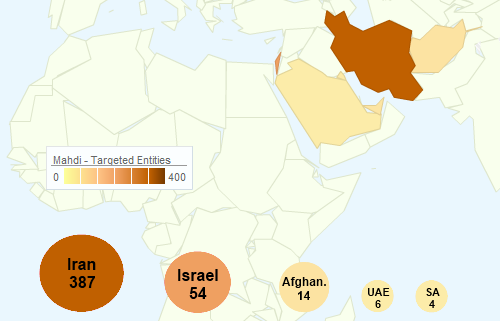
Kaspersky Lab and Seculert identified more than 800 victims located in Iran, Israel, Afghanistan and elsewhere in the course of monitoring control servers associated with cyber/espionage operation over the last eight months.
"Statistics from the sinkhole revealed that the victims were primarily business people working on Iranian and Israeli critical infrastructure projects, Israeli financial institutions, Middle Eastern engineering students, and various government agencies communicating in the Middle East," according to Seculert.
The Madi malware associated with the electronic spying operation is far less sophisticated than the Flame, Duqu and Stuxnet worms associated with previously discovered spying operation in the Middle East, many of which have become associated with operations against Iran's controversial nuclear program. Leaked briefings from the Obama administration suggest both Flame and Stuxnet were joint US/Israeli operations
Madi is a Trojan that allows remote attackers to swipe sensitive files from infected Windows computers, monitor email and instant messages exchanges, record audio, log keystrokes, and take screenshots of victims' activities. in all these respects the malware is similar in capabilities to banking Trojans. Common applications and websites that were spied on include accounts on Gmail, Hotmail, Yahoo! Mail, ICQ, Skype, Google+, and Facebook. Surveillance also tapped integrated ERP/CRM systems, business contracts, and financial management systems.
Kaspersky Lab and Seculert worked together to sinkhole the Madi Command & Control (C&C) servers and thus monitor the spying operation, which they characterise as "amateurish and rudimentary" in execution.
"While the malware and infrastructure is very basic compared to other similar projects, the Madi attackers have been able to conduct a sustained surveillance operation against high-profile victims," said Nicolas Brulez, a senior malware researcher at Kaspersky Lab. "Perhaps the amateurish and rudimentary approach helped the operation fly under the radar and evade detection."
Aviv Raff, Chief Technology Officer, Seculert, added:
"Interestingly, our joint analysis uncovered a lot of Persian strings littered throughout the malware and the C&C tools, which is unusual to see in malicious code. The attackers were no doubt fluent in this language."