 Caleb &
Gladys Byerly with their children
Caleb &
Gladys Byerly with their children
In
2013 Caleb Byerly woke up with a start and
began to furiously write in his journal
everything he saw in a rather unusual dream.
For the previous five years, the small-town
North Carolina resident had been engaged in
mission outreach to indigenous people and
tribal areas in Southeast Asia and the Pacific
Islands.
February
1, 2021 By Mark Ellis —
“In
the dream, I was standing on top of this
mountain. I was looking out across the
mountain, and I saw a tribe of people,” he
told The Unseen Story. Caleb and his wife,
Gladys, live in Moravian Falls, a town of 1400
in the foothills of the Brushy Mountains.
He
had never seen the tribe before, so he asked,
“What tribe are you? What people are you?”
“We’re
the Tinananon tribe,” they replied.
Caleb had never heard of this people group and
he began to carefully observe their actions in
his dream.
A
tribal chief walked forward carrying a musical
instrument. Caleb happens to be an instrument
maker by profession, so his eyes “zoomed in”
to study the distinctive design of an
instrument unlike anything he had ever seen
before.
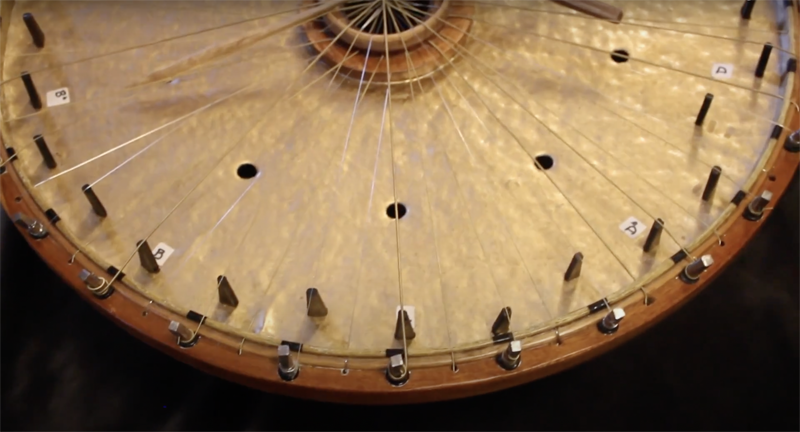
It
had 30 strings going all the way around the
top of a golden bowl, from the outside,
crisscrossing in the middle of the instrument.
“I suddenly got a full download of everything
about this instrument, what dimensions the
instrument was, what material it was made out
of, even like how it was tuned and how it was
played. After that, I kind of zoomed back out.
“This
tribal chief, he took the instrument and he
put it on the table. He took two small sticks,
and he began to play this instrument. As he
played the whole tribe started to dance and
they started to worship. This kind of sound of
worship just filled the place. It was as if
heaven and earth just collided. After that I
woke up from the dream.”
God
has spoken to Caleb through dreams previously,
so he meticulously recorded in his journal the
name of the Tinananon tribe. He made detailed
drawings of the bowl, its dimensions and
materials, a wooden ring that goes around the
bowl, the strings connected by wooden pegs,
and the two sticks used to play the
instrument.
“I
feel like when God speaks to you, it’s an
invitation to partner and walk with God. It’s
not just God commanding you to do things or
God just saying do this, do that. But it’s the
Holy Spirit inviting you into some new journey
that he’s calling you into, and it’s connected
to you, it’s connected to your DNA and your
calling. I really value that a lot. I really
thought that this would be a really exciting
thing to follow with the Lord.”
Caleb
began to search online for any reference to a
Tinananon people group but came up short. “I
contacted different organizations like
Wycliffe Bible Translators, and Summer
Institute of Linguistics to see if they knew
anything about this tribe. But everywhere I
searched, I could not find that word. I tried
the different spellings, but just couldn’t
find anything there. So I kind of gave up on
that.”
But
as a professional instrument maker, he was
intrigued by the idea of recreating the
instrument he saw in the dream. “I’m gonna
make this thing!” he decided. Even though he
had not put metal and wood together in that
way, he was up for the challenge.
“I
got into my shop, and I just kept breaking
this thing. I kept breaking things and
snapping things. I could not figure out this
one process. I got really frustrated. I was
like, I’m just gonna put this thing to the
side. I just couldn’t figure it out.
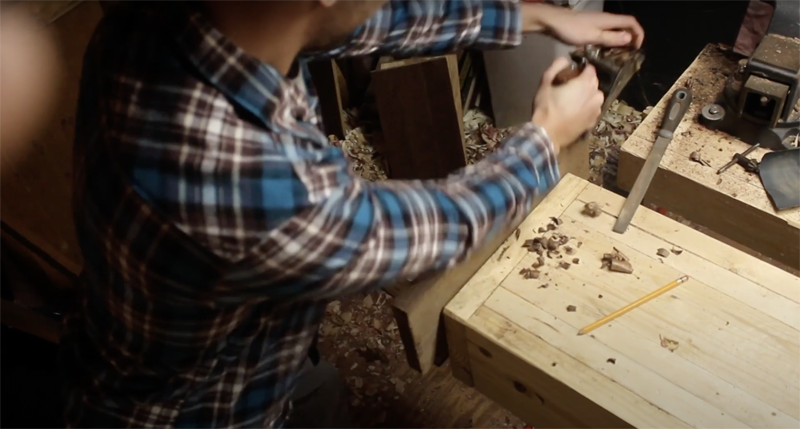 .
.Caleb in his shop (Evergreen Missions)
“So,
I kind of gave up on the whole dream. I felt
like I had done my part. I wasn’t getting
anywhere. So I just kind of gave it up.”
Trip
to the Philippines
About
six months later, he took a mission trip to
the island of Mindanao in the southern
Philippines, an area where he had previously
been involved in ministry.
“I
was on a Jeepney, which is like a public
transportation. There was this man that was
sitting on the other side of me. I could tell
this guy was staring at me. I was like, what’s
this guy doing? Every time that I would look
at him, he would like look away.”
Caleb
knows the national language of the
Philippines, Tagalog, so he spoke to the man.
“As I was talking to him, it turns out that
he’s a believer! So we’re chatting and then
right in the middle of our conversation, I
heard the Lord speak to me. It wasn’t an
audible voice or anything. It was just felt.”
The
Lord spoke to Caleb’s heart and said, I
want you to ask that man about the Tinananon.
Inside,
Caleb resisted. No,
I’m not going to ask this man about the
Tinananon, he thought. I’ve
already tried to do all my research.
A
second time the Lord nudged his heart, Ask
this man about the Tinananon.
Caleb
built up his courage and said meekly, “Sir, do
you happen to know Tinananon?
As
soon as he said he word Tinananon, the man’s
eyes got really big.
He
leaned in and said, “Hey, that’s my people —
that’s my tribe! How do you know my people?”
Caleb
was rendered speechless for a moment. “Tell me
everything you know about your tribe.”
Manigos
began to explain that his tribe lives in a
deep mountainous region of Mindanao. “This
area is a really dangerous place,” he said.
“No one from outside goes to this place.”
Manigos estimated his people group numbers
between 70,000 and 100,000 people, scattered
throughout the mountainous region in pockets.
Caleb
invited Manigos to follow him to the place he
was staying and showed him his journal entry
with the word Tinananon.
Manigos
began shaking his head, and tears streamed
down his face.
He
said, “Remember earlier on the bus, I kept
looking at you.”
“Yes,
what was that all about?”
“I
kept looking at you, and the reason why is
because I’ve seen you before…I just realized
where I saw you, I also saw you in a dream.”
Manigos
explained that was born in the Tinananon
tribe. He left as a young man and went to
Davao City, the largest city on the island of
Mindanao, with 1.8 million people. He came to
know Jesus while he lived in the city, then
God called him back to his tribe through a
dream.
In
the dream, Manigos had gone back to evangelize
his people – with Caleb! “He saw me in his
dream,” Caleb said, “and I came and joined
him. He and I began to minister and bring the
good news of Jesus to his people.”
They
were filled with wonder and awe at the way God
brought them together. The two men stayed
together for several days. “We all worshipped
together and prayed together for a few days.
Manigos invited Caleb to visit his tribe.
“Yeah,
I would love to go to your tribe,” Caleb
replied, “but I need to ask my wife first.”
His wife, Gladys, was eight months pregnant at
the time. Going on a potentially dangerous
journey, immediately before the birth of their
first child was a big decision they had to
make.
After
Caleb flew home to North Carolina, he and
Gladys sought the Lord’s direction. “We felt
like the Lord’s hand was on it,” he said. “And
if the Lord showed this, up to this point,
then He would continue to be with us. So I
decided I was going to go, but I wanted to get
back in the shop and try to make this
instrument again.”
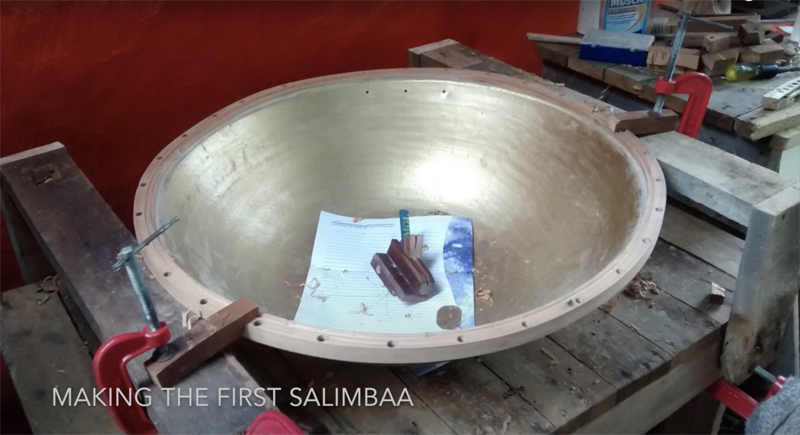
Caleb
got very focused and asked the Holy Spirit to
help him. “The Lord gave me wisdom, gave me
insight on the process of what to do…with the
help of the Holy Spirit and my wife, we were
able to get it. I finally made this
instrument!
He
put the strings on it for the first time. “I
tuned it up the way I heard it in the dream. I
got the two little sticks. And I started to
play it. It was that same sound, the same
sound that I heard in the dream. And I was
like, this is it. I was just really excited
about it.”
Caleb
bought a plane ticket and left the next day
for the Philippines, taking the instrument
with him.
He
met a tribal friend named Ansulao and his new
friend, Manigos, at the border of the mountain
range closest to the tribe. “All three of us,
we got on this one little motorbike. It was
like 120 cc, a little motorbike.”
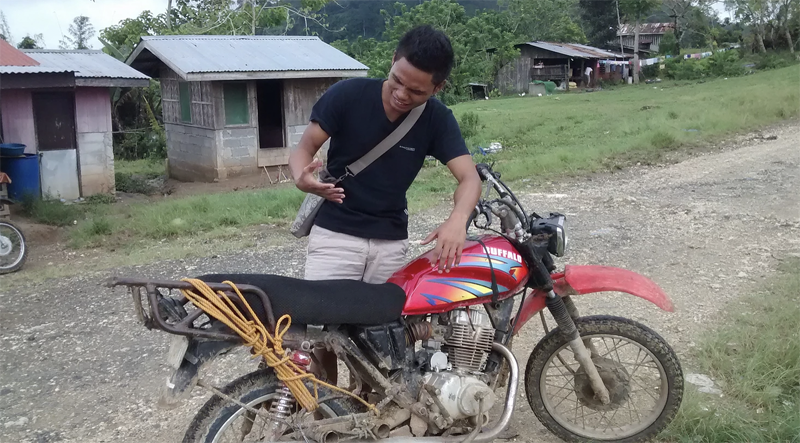 .
.The motorbike they took into the mountains (Evergreen Missions)
A
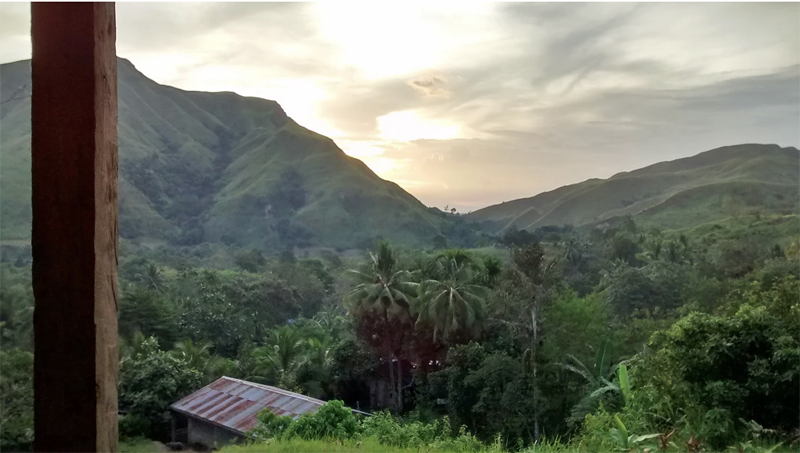
large storm had passed through the steep,
undeveloped mountainous area the day before.
“It was really muddy, very hard to get through
there. And then while we were on this
motorbike, another storm came. I was trying to
hold this instrument, and I couldn’t hold it
to my left or my right, so I had to put it
above my head.
“Imagine
three people on a little motorcycle. I was
holding this musical instrument above my head
trying to balance.”
They
came to a hanging bridge, which consisted of
two ropes and primitive wood planks. They
managed to get across the bridge and were
going up a steep hill, when the motorbike
popped its gear and went into neutral.
Suddenly
they were flying backward, toward the cliff.
The motorbike wheel hit a rock and all three
men went flying. “Thank the Lord, we landed in
this smooth, green patch of grass, just feet
away from the cliff, the drop-off cliff!”
As
they entered the area of the Tinananon tribal
group, Caleb heard the still small voice of
the Lord once more: Caleb,
I want you to take the instrument to the
chief.
They
started asking about how to find the chief’s
house, which they learned was another three
and a half hours away, on the other side of
the mountain.
By
the time they reached the chief’s house it was
almost evening. Mud covered their clothing as
they approached a small wooden house and
knocked on the door.
When
the chief opened the door he had a shocked
expression on his face – especially to see an
American in this remote area.
“We
are, I am coming to your tribe for the first
time,” Caleb said. “I just wanted to
give this as a gift to you,” he said, holding
the instrument in his outstretched arms,
covered by a blanket.
The
chief placed the instrument on a table and
took the blanket off of it. “He saw this
instrument and he started staring at it. He
kept looking at this instrument over and over
again. He kept asking me, ‘Where did you get
this instrument from?”
“Well,
I just kind of made it,” Caleb replied.
“No,
no, I’m serious. Where did you get this
instrument from?”
“Well,
if you really want to know. Last year, I had
this dream. In the dream I heard the name of
your tribe, the Tinananon, for the first time.
I’d never heard that word before. I also saw
this musical instrument in the dream. I felt
like my God has given this dream to me.
“After
that I met this man, Manigos, who is from your
tribe, and he helped me lead me to your house
today. I was able to make this instrument. I
just felt like I wanted to give this
instrument to you today.”
The
chief continued shaking his head in disbelief,
examining the instrument carefully, asking
questions about it. He summoned other leaders
from the Tinananon tribe and they walked
around it incredulously, pointing at it,
saying “Salimbaa.”
“They
have their own native tongue,” Caleb notes.
“And I don’t totally understand their
language. So I was pretty lost about what they
were talking about.”
Finally,
the chief motioned to them and said, “I need
to show you something.” They left his house
and went down a small pathway over to another
structure.
“They
call the house Paluvaran,
which means House of Prayer in their language.
This is the place where they worship. But it’s
also sort of a storehouse of all their kind of
ancient articles of their tribes. They have
pottery work, metalwork, weaving, all these
different things that are tangible evidence
that their tribe has been living and existing
for hundreds of years.
“I
was amazed by this place. They had all these
musical instruments on the side of the wall.”
As a professional instrument maker, Caleb
found it fascinating, incredible.
The
chief informed him there were different
musical instruments for each of their gods.
“They have the god of the tree, the god of the
stone, god of the river. And they’re not
necessarily gods, but they believe that the
one true God or the Creator has sent down
angels to guard these different things like
the angel of the river, the angel of the
stone.
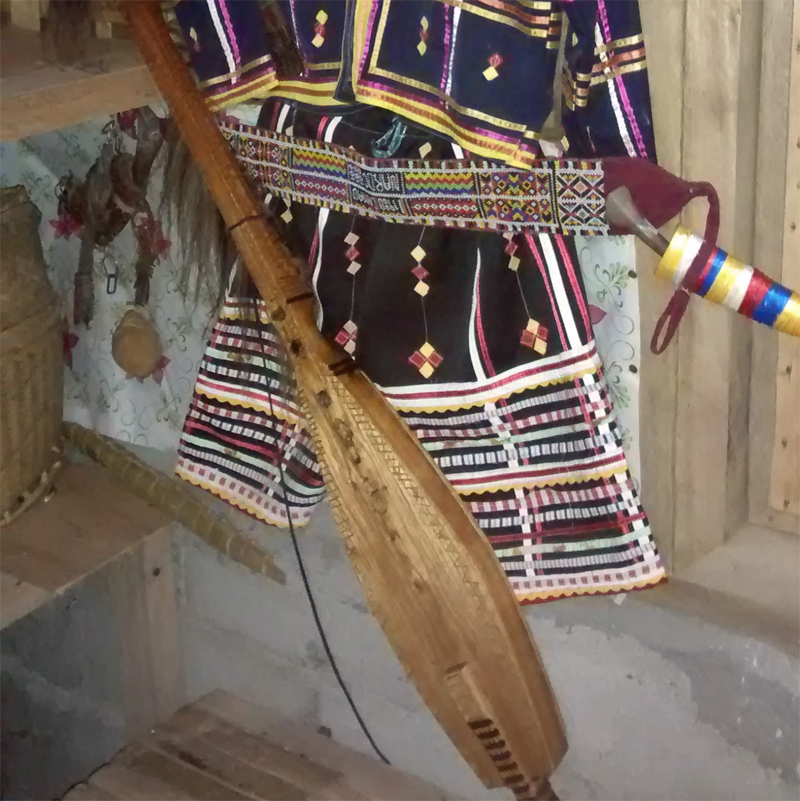 .
.One of the musical instruments in the Paluvan along with traditional clothing (Evergreen Missions)
“Instead
of praying and worshiping directly to God,
they pray and worship to these different
angels; the angels would be the ones to
connect them to God. And so it’s a little bit
different, but it’s not completely like they
believe in many different gods, they believe
in the one true God.”
Caleb
noticed there was one spot that was empty on
the wall between the other instruments. “They
said that somewhere between 100 and 150 years
ago, there was a tribal war. During this war,
their most valuable musical instrument that
worshiped the God of all gods was taken away
from them.”
In
response, they lamented for a time and created
a song that goes something like this:
The
Salimbaa was taken away from us,
God
is going to redeem it back to us one day.
“It
was a prophecy. This instrument is the
instrument that worships the God of all gods.
They said, ‘Today, you brought the Salimbaa to
us!’”
Caleb
was blown away. “Oh my goodness!” he
exclaimed.
After
that there was a small gathering of tribal
leaders. “This is it! This is the Salimbaa!”
they cried. Everyone knew what it was when
they saw it and heard it played.
Caleb
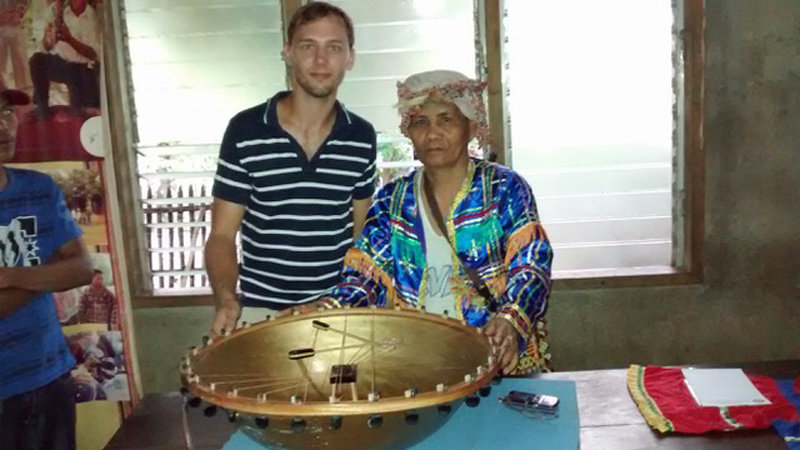
learned the Salimbaa’s golden bowl, with
strings stretching from side to side around
the bowl, that the convergence in the middle
is the place where the Tinananon believe the
Salimbaa connects heaven and earth.
 .
.The place in the middle
“They
said that, in the last time, in the last days,
God is going to be coming down from heaven,
and he’s going to call all the righteous
people to him. When God comes down from
heaven, God is going to be riding on the
inside of the Salimbaa, as if the Salimbaa was
an aircraft that connects heaven and earth.”
Their
name for the God above all gods is Manama.
“They started praying to Manama…and they
dedicated this instrument back to God.”
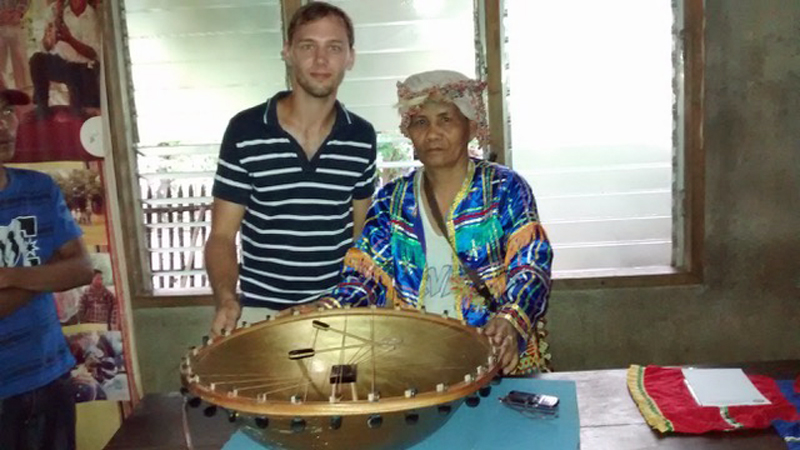 .
.Caleb with Chief Suhat and the Salimbaa instrument (Evergreen Missions)
As
a sign of special honor, the chief placed a
tribal leader’s headpiece on Caleb’s shoulder.
“We now consider you a chief of the Tinananon
tribe,” he said. “Whatever you believe God is
calling us or leading us into, we’re going to
follow you.”
Reeling
from the whole experience, Caleb was humbled
by the gesture. They stayed with the chief,
Datu Lipatuan Suhat, for three days.
“There
wasn’t a lot that manifested with him giving
his life to Jesus,” Caleb told God Reports. “I
did pray with him a lot and prophesied over
him. But after we left, we didn’t return for a
few months, but during that time, within a
month or two, the chief had an encounter with
Jesus, and the Lord spoke to him and he wrote
everything out. That is when he gave his heart
to Jesus.”
On
the second visit, Caleb asked Chief Suhat how
he could help the tribe.
“Well,
if you can help us with one thing, I want you
to help us translate the Bible into our
language.”
In
January 2015, Caleb arranged for Translators
Association of the Philippines to meet with
all 50 chiefs of the Tinananon tribe.
“Some
of the chiefs didn’t want the Bible to be
translated and others did,” Caleb told God
Reports. “There was tension in the room. None
of us as foreigners felt led to speak up. The
chief came up to the front and opened up the
Cebuano Bible, from Genesis.”
Caleb
learned the Tinananon believe that God came
down and took the soil of Mindanao and put it
in his hands and blew on it and that is when
the first man came alive.
“We
believe God made man from his breath,” Chief
Suhat said, “by taking the dust of the earth
and breathing on it.”
Chief
Suhat proceeded to read the biblical account
of the creation of man:
And
the LORD God formed man of the dust of the
ground, and breathed into his nostrils the
breath of life; and man became a living
soul. (Genesis 2:7)
Then
the chief paused, set the Bible down, and
said: “It’s only the first few pages, imagine
what it would be to have the whole Bible
translated.”
The
other chiefs nodded their heads in agreement.
“That’s true,” they said, and all 50 agreed to
let the translators begin their project.
Chief
Suhat passed away in 2015, shortly after the
translation process began.
Since
then, there have been four churches planted
among the Tinananon. “It’s just amazing, the
open doors that the chiefs have given us for
this tribe,” Caleb says.
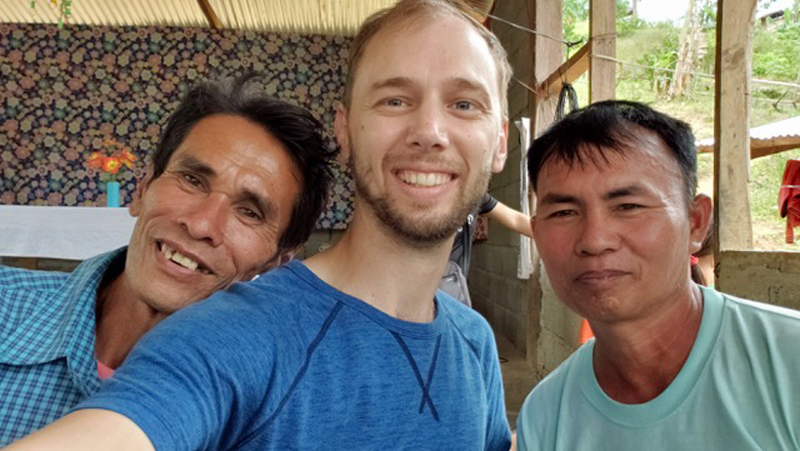 .
.Manigos (left) with Caleb and another Tinananon pastor
“It
was mostly through Manigos,” he adds. “He
could speak the language and knew the culture.
He has such a heart for his people. He has a
God-given call to his people.
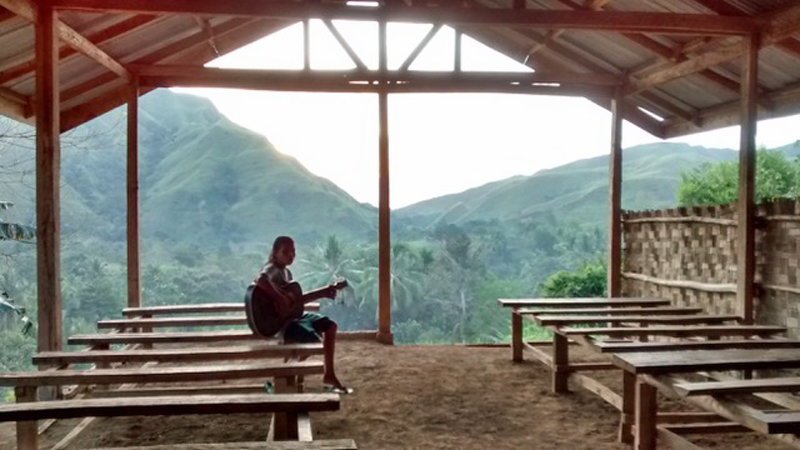 .
.First church built by Manigos among the Tinananon
“Last
year (2019) we went and visited the tribe and
he had taken this small group of people on
fire for the Lord and it’s grown to hundreds
of believers there now.”
 .
.The first believers among the Tinananon (Evergreen Missions)
Could
God connect an instrument maker living in
Moravian Falls, North Carolina with an
unreached tribe in the Philippines through a
dream?
In
1727 the Moravian Church established a
continuous prayer movement that ran
uninterrupted, 24 hours a day, for 100 years.
Moravian missionaries were part of launching
the first large-scale Protestant missionary
movement, beginning in 1732.
Did
God touch Caleb and Manigos in response to the
Moravians’ prayers?
“I
felt like the Lord had arranged everything,”
Caleb says, “in such a perfect way of
organizing everything, just perfect timing. It
was such an amazing series of events that took
place that I couldn’t take any kind of claim
for it.
“The
best way I could explain is I was right there
in the middle of the journey with God. I felt
like He was there in the moment. I was like,
yeah, this is Him. This is Him, this is what
He did.
Caleb
and Gladys Byerly are the founders of
Evergreen Missions. Their focus is to
partner with God in bringing His kingdom to
the Earth. Caleb and Gladys focus mostly on
mentoring and discipling indigenous leaders,
who will go to their own people and bring
them life from Christ Jesus. To learn more,
go here
Adam
Fish and his wife Brooke started The Unseen
Story, which features firsthand accounts
that reveal the reality of God’s love. Their
interview/podcast with Caleb Byerly, along
with many other great stories may be
found here
Source: http://godreports.com