
Astronomers
have discovered a new
comet. It is currently moving in front of the stars of
the constellation Cancer the Crab. It’s out beyond
Jupiter’s orbit still, now, but it’s heading for a
close encounter with the sun in 2013. Called C/2012 S1
(ISON) by astronomers, its orbital characteristics
indicate it might become a very bright object in
Earth’s sky, beginning in November 2013. If so, all of
us around the globe should be able to see it late next
year.
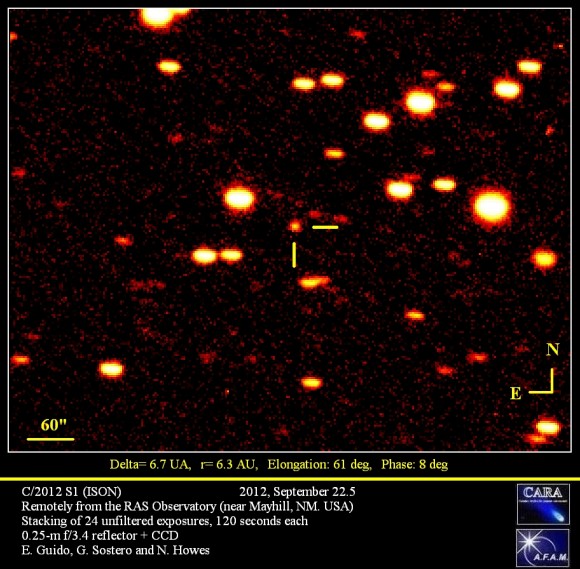
At its discovery in September
2012, Comet C2012 S1 (ISON) was beyond the orbit of
the 5th planet from our sun, Jupiter. It will sweep
into the inner solar system in 2013. This is a false
color image of the comet, showing the coma
surrounding the comet’s central nucleus, via
Remanzacco Observatory
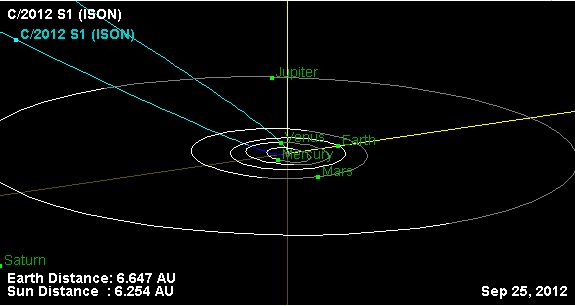
This comet’s orbit will bring
it near the sun in 2013. By November 2013, it might
become a bright comet to the eye! Image via NASA’s
Jet Propulsion Laboratory
Eastern
European and Russian astronomers announced the new comet on
September 24, 2012. Discovery magnitude was 18.8
– in other words, extremely faint. Vitali Nevski of
Vitebsk, Belarus and Artyom Novichonok of Kondopoga,
Russia spotted the comet on CCD images obtained on
September 21 with a 0.4-m f/3 Santel reflector of the
International Scientific Optical Network (ISON) near
Kislovodsk, Russia. Afterwards, astronomers at
Remanzacco Observatory in Italy confirmed the comet’s
presence with the image above.
No
doubt about it … comets have a mystique. Once
considered omens of doom, we now know them as icy
visitors from the outer solar system that sweep near
our sun, then disappear again into the depths of
space, perhaps never to return. People get excited
about comets. They are temporary visitors to
our region of the solar system. This comet will be no
exception.
In
November 2013, Comet ISON will pass less than 1.8
million kilometers (1.1 million miles) from the sun’s
surface. That sounds like a lot, but it’s actually
quite close – over 100 times closer to the sun than
Earth. This near sweep past the sun might keep distant
enough to prevent its breaking to pieces, as sometimes
happens. If all goes well, the terrific heating Comet
ISON will undergo when it’s closest to our parent star
might turn the comet into a bright naked-eye object.

Comet Lovejoy was a sight to
behold from Earth's Southern Hemisphere in late
2011. Here the comet is reflected in the water of
Mandurah Esturary near Perth on December 21, 2011.
Image Credit: Colin Legg.
Of
course, comets don’t always live up to expectations.
Comet ISON might break up into fragments, as the much-hyped Comet Elenin did
around August 2011.
On the
other hand, Comet ISON might survive its encounter
with the sun as Comet Lovejoy did in
late 2011. If so, it might go on to illuminate our
skies with its beauty. And there is one thing we can count
on. That is, if Comet ISON does become a bright comet,
visible to the eyes of watching earthlings, it will be
beautiful. All bright comets are.
If it
does survive its close encounter with the sun in 2013,
and if it does become bright enough to be seen with
the eye, astronomers say Comet ISON’s best appearance
won’t be limited to just one hemisphere as Comet
Lovejoy’s was. It’ll be visible to all of us in both
the Northern and Southern Hemispheres for at least a
couple of months, from about November 2013 through
January 2014. If so … worth the wait!
Bottom
line: The comet called C/2012 S1 (ISON) by astronomers
is out beyond Jupiter’s orbit now. But it’s headed for
a close encounter with our sun in 2013 and might
become a spectacular sight from all of Earth around
November of next year.