There
have been some claims on the Internet lately that the first day of
Hanukkah and Thanksgiving won't fall on the same day again for
approximately 79k years. Seemed hard to believe so I set out to find out
whether or not it is true, and it actually is. Some have associated
Hanukkah with the rapture because of the 2 witnesses and the 7 vs 9
candle Menorah as well as it completing the feast cycle for the year.
Maybe this is significant and it's one of many signs in the heavens.
We'll see soon. The article:
Hanukkah and Thanksgiving
January 19th, 2013 at 11:35 pm by Dr. Drang
You
may have noticed that when some seemingly odd calendar coincidence
occurs, people on Twitter start saying and retweeting the most amazingly
dumb things. Like
There are 5 Fridays, 5 @TheSaturdays and 5 Sunday this October, won’t be again for another 823 years!! :)
— Una Healy (@UnaTheSats) Tue Oct 5 2010 5:33 PM CDT
or
Friday the 13th occurs 3 times this year, each 13 weeks apart from the other. This won’t happen again for 666 years. Happy Friday the 13th.
— The Illuminati (@ThelIluminati) Fri Jul 13 2012 7:32 PM CDT
Because I find calendrical calculations interesting, I write posts debunking these odd ideas when I run across them. I always end up learning something in the process.
I guess I’m drawn to these tweets because the claims that “this won’t happen again for x years”
are so preposterous. Their popularity is
predicated on gullibility and the fact that most people don’t know that
calendars repeat every 28 years. Or have never seen a perpetual calendar.
On Thursday, Jason Kottke posted a calendar fact that made the 823- and 666-year cycles seem modest:
This year, the first day of Hanukkah coincides with Thanksgiving Day. Amazingly, this is the first time it’s happened since President Lincoln established Thanksgiving in 1863 and it is also the last time it’ll happen until the year 79,811.
The amazing thing about this is that it’s true. Or nearly true, anyway.
Jason got this tidbit from Jonathan Mizrahi, who wrote two posts about the Thanksgiving/Hanukkah correspondence and also linked to similar posts by the Lansey Brothers and Steve Morse.
The reason this assertion isn’t outlandish, despite claiming a
coincidence that doesn’t recur for over 75,000 years, is that it
concerns two calendars, not one, and they are drifting at different
rates.
The
date of Thanksgiving is determined by the Gregorian calendar—the one
we’re all familiar with: 365 days in a normal year, 366 in a leap year,
leap years every four years but not in century years unless they’re
divisible by 400. Hanukkah is determined by the Hebrew calendar, which
is much more complicated. Leap years in the Hebrew calendar occur every
two or three years and they really leap. Instead of just adding a day, leap years in the Hebrew calendar add an entire month.1
The
complexity comes from the Hebrew calendar trying to be both a solar
calendar (like the Gregorian) and a lunar calendar (like the Islamic).
Although there are months in the Gregorian calendar, they aren’t really
tied to the phases of the moon. The Gregorian’s rules are meant to keep
the equinoxes occurring on roughly the same day every year. The Islamic
calendar, in contrast, doesn’t care about the solar cycle or the
seasons—it’s a purely lunar calendar that keeps its months aligned with
the moon. This is why Ramadancan occur in any part of the solar year.
In the Hebrew calendar, months are either 29 or 30 days long, in keeping with the lunar cycle of
29.53 days. To keep in sync (on the average) with the solar cycle,
years have either 12 or 13 months. They can be as short as 353 days or
as long as 385 days. On the average, the Hebrew calendar year is
365.2468 days long.
This
is the reason for the drift relative to the Gregorian calendar, which
is 365.2425 days long on average. The difference of 0.0043 days per year
means that the Hebrew calendar gains a day on the Gregorian every 233
years. This is why the Hebrew calendar and the Gregorian are moving
apart and why the first day of
Hanukkah won’t be on Thanksgiving again for a very, very long time.
This
doesn’t mean the Gregorian calendar is right, by the way. It’s
drifting, too. If we define a year to be the time from one vernal
equinox to the next—a common definition, albeit one with a Northern
Hemisphere bias—the average length of a year is 365.24219 days. This is
called the mean tropical year. Thus, relative to the mean
tropical year, the Gregorian calendar is drifting by about one day every
3,226 years, and the Hebrew calendar is drifting by about one day every
217 years.
The
Julian calendar—the one with leap years every four years with no
exceptions—has an average year length of 365.25 days. Its
drift relative to the mean tropical year is almost exactly one day
every 128 years. This explains why the Gregorian calendar reformation
was necessary: by 1582, the Christian calendar set by the First Council of Nicaea in
325 (when Christians decided they needed a calendar of their own
because it was just too embarrassing to keep asking Jews when Easter
was) had gained about 10 days on the mean tropical year; the vernal
equinox was on March 11 instead of March 21. This is why 10 days were
cut from the calendar. By the time England adopted the Gregorian
calendar in 1752, the Julian had gained another day, and England had to cut 11 days from its calendar.
The
Julian calendar’s drift of one day every 128 years suggests a more
accurate calendar reform than Gregory’s. Because 128 is a multiple of 4,
the calendar could simply skip leap year every 128th year. This would
give an average year length of 365.2421875 days and the drift would be
reduced to a shockingly low one day every 400,000 years.
Or not. Unfortunately, the mean tropical year is itself drifting for
various astronomical reasons, so the apparent accuracy of the previous
paragraph is illusory. So much for the Drang calendar.
So anyway, where was I? Oh
yeah, Thanksgiving and Hanukkah. I wanted to see if I could reproduce
Jonathan Mizrahi’s calculation of the next time Thanksgiving would fall
on the first day of Hanukkah. According to Jonathan, the drift of the
Hebrew calendar is making Hanukkah come later and later in the Gregorian
year, and it won’t come back to a date where it can match Thanksgiving
until it’s worked its way all the way around the Gregorian year—at least
75,000 years.
This
is, as Jonathan rightly points out, thoroughly unrealistic because it
assumes that neither calendar will be adjusted in the meantime and that
they’ll both still be in use. But it’s fun to do the calculation.
I downloaded Reingold and Dershowitz’s Lisp code from their book’s website at Cambridge University Press and used its functions as a base to check for the coincidence of the two dates.
Here’s my code, called “hanukkah-thanksgiving.cl.”
 1  (load "calendrica-3.0.cl")
 2  (use-package "CC3")
 3
 4  (defun thanksgiving (g-year)
 5    (nth-kday 4 thursday (gregorian-date g-year november 1)))
 6
 7  (defun first-hanukkah-p (date)
 8    (equal '(9 25) (cdr (hebrew-from-fixed date))))
 9
10  (defun first-hanukkah-thanksgiving-p (g-year)
11    (first-hanukkah-p (thanksgiving g-year)))
12
13  (defun hanukkah-thanksgivings (y1 y2)
14    (let ((yrs nil))
15      (loop for y from y1 to y2 do
16        (if (first-hanukkah-thanksgiving-p y) (setq yrs (cons y yrs))))
17      (reverse yrs)))
The
first two lines loaded Reingold and Dershowitz’s code and made it
available for me to call. The rest of the code defines functions that I
use later in an interactive session:
- The
thanksgivingfunction on Lines 4-5 returns the date2 of Thanksgiving for a given Gregorian year. - The
first-hanukkah-pfunction on Lines 7-8 returns true or false (Tornilin Lisp) depending on whether the date provided lands on the 25th day of the 9th month (Kislev), the first day of Hanukkah. - The
first-hanukkah-thanksgiving-pfunction on Lines 10-11 builds on the earlier functions to check whether Thanksgiving and the first day of Hanukkah coincide for a given Gregorian year. - The
hanukkah-thanksgivingsfunction in Lines 13-17 takes two Gregorian years and returns a list of all the years in that range where the two holidays coincide.
(It’s
been years since I programmed in Lisp or Scheme, but I was quickly
reminded of how powerful and elegant it feels to build up programs
function by function. I was also reminded of how much I hate
the
let construct.)Despite its relatively slow speed, I used CLISP (installed via Homebrew)
to do my calculations because it has a nice interactive environment and
it loaded the Reingold and Dershowitz code without complaining.3 My interactive session went like this.
[1]> (load "hanukkah-thanksgiving.cl")
;; Loading file hanukkah-thanksgiving.cl ...
;;  Loading file calendrica-3.0.cl ...
;;  Loaded file calendrica-3.0.cl
;; Loaded file hanukkah-thanksgiving.cl
T
[2]> (hanukkah-thanksgivings 1942 80000)
(2013 79043 79290 79537 79564 79635 79784 79811 79882)
I
chose 1942 as my starting point, because that’s when Thanksgiving got
its current definition as the fourth Thursday in November. The Lansey Brothers post has
a good rundown of how Thanksgiving has changed since it was officially
instituted in 1863. I chose 80,000 as the end point because both the
drift rate and Jonathan’s post suggested I should get at least one hit
before then.
As
you can see, I did find a coincidence in 79,811, as Jonathan said, but
it wasn’t the next after this year’s. According to my calculations,
the next coincidence will be in 79,043. That’s also the year Steve Morse got (down at the very end of his post) for the next coincidence. I checked with Wolfram Alpha, which also showed a match in 79,043.
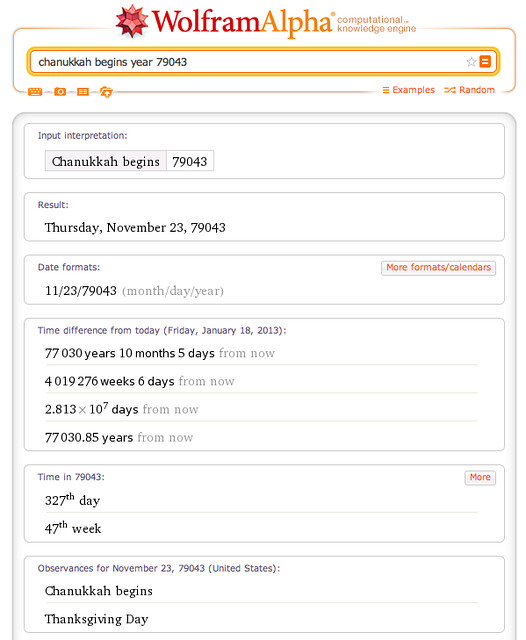
This
gave me more confidence that
my answer was right, but I still wondered why Jonathan got a different
result. My guess is that he was looking not just for Thanksgivings, but
Thanksgivings on November 28. I checked the dates of Thanksgiving for
all the years I calculated:
[3]> (loop for y in '(2013 79043 79290 79537 79564 79635 79784 79811 79882) do
(print (gregorian-from-fixed (thanksgiving y))))

(2013 11 28)
(79043 11 23)
(79290 11 23)
(79537 11 25)
(79564 11 26)
(79635 11 22)
(79784 11 25)
(79811 11 28)
(79882 11 23)
Sure
enough, 79,811 is the next year the first day of Hanukkah falls on a
Thanksgiving that’s on the 28th. This isn’t proof, but it is suggestive.
The
upshot is that we can all breath easier. The next Hanukkah/Thanksgiving
concordance will happen 768 years earlier than we thought.
Steve M